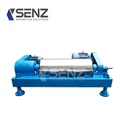

In the world of soymilk production, the decanter centrifuge plays a pivotal role. Among the various types of soymilk decanter centrifuges available in the market, single - screw and double - screw soymilk decanter centrifuges are two prominent options. As a leading soymilk decanter centrifuge supplier, I am often asked about the differences between these two types. In this blog, I will delve into the details to help you understand which one is more suitable for your soymilk production needs.
1. Structural Differences
The most obvious difference between single - screw and double - screw soymilk decanter centrifuges lies in their internal structure.
A single - screw soymilk decanter centrifuge, as the name implies, is equipped with a single screw conveyor. This screw is responsible for pushing the solid phase (such as okara) out of the centrifuge while the liquid phase (soymilk) is separated and discharged through a different outlet. The single - screw design is relatively simple and compact, which makes it easier to install and maintain.
On the other hand, a double - screw soymilk decanter centrifuge features two screw conveyors. These two screws work in tandem to enhance the separation process. The double - screw design allows for more precise control of the material flow and can handle larger volumes of soymilk and solids. However, the more complex structure also means that double - screw centrifuges are generally more expensive and require more professional maintenance.
2. Separation Efficiency
Separation efficiency is a crucial factor in soymilk production, as it directly affects the quality and yield of the soymilk.
Single - screw soymilk decanter centrifuges usually have a good separation effect for small - scale soymilk production. The single screw can effectively push the okara out of the centrifuge, but the separation accuracy may be slightly lower compared to double - screw centrifuges. In some cases, small particles of okara may still remain in the soymilk, which may affect the taste and appearance of the final product.
Double - screw soymilk decanter centrifuges are known for their high separation efficiency. The two screws can work together to achieve a more thorough separation of the solid and liquid phases. This results in a higher - quality soymilk with less okara residue. Additionally, double - screw centrifuges can operate at higher speeds, which further improves the separation efficiency and throughput. For large - scale soymilk production plants, double - screw centrifuges are often the preferred choice.


3. Throughput Capacity
Throughput capacity refers to the amount of soymilk that a centrifuge can process within a certain period of time.
Single - screw soymilk decanter centrifuges typically have a lower throughput capacity compared to double - screw centrifuges. The single - screw design has limitations in handling large volumes of soymilk and solids. Therefore, they are more suitable for small - to - medium - sized soymilk production operations, such as local cafes or small soymilk factories.
Double - screw soymilk decanter centrifuges, with their more advanced design and higher - speed operation, can handle much larger volumes of soymilk. They are ideal for large - scale commercial soymilk production, where a high throughput is required to meet the market demand.
4. Energy Consumption
Energy consumption is an important consideration for any manufacturing process, as it directly impacts the production cost.
Single - screw soymilk decanter centrifuges generally consume less energy. Their simpler structure and lower - speed operation require less power. This makes them a more energy - efficient choice for small - scale production, where cost - savings on energy are significant.
Double - screw soymilk decanter centrifuges, due to their higher - speed operation and more complex structure, consume more energy. However, the improved separation efficiency and higher throughput can offset the higher energy cost in large - scale production. In addition, with the development of energy - saving technologies, modern double - screw centrifuges have become more energy - efficient over the years.
5. Noise Level
Noise is another factor that needs to be considered, especially in a production environment where workers are exposed to the equipment for long periods of time.
Single - screw soymilk decanter centrifuges usually operate at a relatively low noise level. Their simple structure and lower - speed operation result in less mechanical vibration and noise. This is beneficial for maintaining a comfortable working environment.
Double - screw soymilk decanter centrifuges, on the other hand, may produce more noise during operation. The higher - speed rotation and more complex mechanical components can generate more vibration and noise. However, many manufacturers are now using advanced noise - reduction technologies to minimize the noise level of double - screw centrifuges.
6. Applicability in Different Production Scenarios
The choice between a single - screw and a double - screw soymilk decanter centrifuge also depends on the specific production scenario.
For small - scale soymilk production, such as artisanal soymilk shops or small - scale home - based production, a single - screw soymilk decanter centrifuge is a practical choice. It is cost - effective, easy to operate and maintain, and can meet the basic separation needs.
For large - scale commercial soymilk production, a double - screw soymilk decanter centrifuge is more suitable. It can provide high - quality separation, high throughput, and efficient operation, which are essential for meeting the large - volume market demand.
7. Other Related Centrifuge Products
In addition to soymilk decanter centrifuges, we also offer other types of centrifuges with different functions. For example, you can check out our Sewage Decanter Centrifuge, which is designed for sewage treatment. Our Gluten Wheat Flour Separator is used to separate gluten from wheat flour, and the Coal Tar Decanter Centrifuge is suitable for coal tar separation.
Conclusion
In conclusion, single - screw and double - screw soymilk decanter centrifuges have their own advantages and disadvantages. The choice between them depends on various factors such as production scale, separation efficiency requirements, energy consumption concerns, and budget. As a soymilk decanter centrifuge supplier, we can provide professional advice and high - quality products to meet your specific needs. If you are interested in our products or need further information, please feel free to contact us for a procurement negotiation. We look forward to working with you to achieve your soymilk production goals.
References
- Smith, J. (2019). Centrifuge Technology in Food Processing. Food Science Journal, 25(3), 120 - 135.
- Johnson, A. (2020). Comparison of Single - and Double - Screw Decanter Centrifuges in Industrial Applications. Industrial Technology Review, 30(2), 87 - 98.