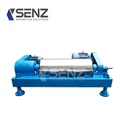

As a leading supplier of soymilk decanter centrifuges, I often encounter inquiries from customers about the differences between manual and automatic soymilk decanter centrifuges. This blog post aims to provide a comprehensive comparison of these two types of centrifuges to help you make an informed decision when choosing the right equipment for your soymilk production.
Working Principle
Let's start with the basics - the working principle. Both manual and automatic soymilk decanter centrifuges operate on the principle of centrifugal force to separate solid particles from liquid. When the centrifuge rotates at high speed, the denser solid particles are forced to the outer wall of the centrifuge bowl, while the lighter liquid phase remains in the center and can be discharged separately.
In a manual soymilk decanter centrifuge, the operator has to control every step of the process. This includes starting and stopping the centrifuge, adjusting the rotation speed, and manually discharging the separated solids and liquids. It requires a certain level of skill and experience to operate the machine effectively.
On the other hand, an automatic soymilk decanter centrifuge is equipped with advanced control systems that can automate most of the processes. The machine can be programmed to start and stop at specific times, adjust the rotation speed according to the type of soymilk being processed, and automatically discharge the separated phases. This significantly reduces the need for manual intervention and increases the overall efficiency of the production process.
Efficiency and Productivity
One of the most significant differences between manual and automatic soymilk decanter centrifuges lies in their efficiency and productivity. An automatic centrifuge can process a larger volume of soymilk in a shorter period compared to a manual one. This is because the automatic machine can operate continuously without the need for frequent operator intervention. It can also adjust the processing parameters in real - time to ensure optimal separation, resulting in higher - quality soymilk and less waste.
For example, in a large - scale soymilk production facility, an automatic decanter centrifuge can handle several tons of soymilk per hour, while a manual centrifuge may only be able to process a few hundred kilograms in the same time frame. This makes the automatic centrifuge a more suitable choice for high - volume production.
Precision and Consistency
In terms of precision and consistency, automatic soymilk decanter centrifuges have a clear advantage. Since they are controlled by advanced algorithms, they can maintain a high level of accuracy in terms of separation efficiency, rotation speed, and discharge time. This ensures that every batch of soymilk produced has the same quality and characteristics.
Manual centrifuges, however, are more prone to human error. Even the most experienced operators may make mistakes in adjusting the settings or discharging the phases, which can lead to inconsistent product quality. For businesses that require a high degree of product consistency, such as those supplying soymilk to large retailers or food manufacturers, an automatic centrifuge is the better option.
Cost
Cost is always an important factor when making a purchasing decision. Manual soymilk decanter centrifuges are generally less expensive to purchase compared to automatic ones. They also have lower maintenance costs since they have fewer complex components. However, when considering the long - term cost, the picture may be different.
Although an automatic centrifuge has a higher upfront cost, its higher efficiency and productivity can lead to significant cost savings in the long run. It can reduce labor costs, increase production output, and minimize waste, which can offset the initial investment over time. Additionally, the consistent product quality produced by an automatic centrifuge can help businesses command higher prices in the market.
Ease of Use and Maintenance
Manual soymilk decanter centrifuges are relatively simple to operate and maintain. They have fewer components, and the operator can easily access and clean them. This makes them a good choice for small - scale soymilk producers or those with limited technical expertise.
Automatic centrifuges, while more complex in terms of operation, come with user - friendly control interfaces that make them accessible to operators with basic training. They also often have self - diagnostic features that can detect and report any issues, making maintenance easier. However, when major repairs are needed, they may require the assistance of professional technicians due to their advanced technology.
Applications in Different Scenarios
The choice between a manual and an automatic soymilk decanter centrifuge also depends on the specific application scenario.
For small - scale soymilk shops or home - based production, a manual centrifuge may be sufficient. It is affordable, easy to operate, and can meet the relatively low - volume production requirements. These businesses may not need the high - speed and fully automated features of an automatic centrifuge.
In contrast, large - scale soymilk factories, food processing plants, and commercial beverage producers will benefit greatly from an automatic soymilk decanter centrifuge. The high productivity, precision, and consistency of the automatic machine can help them meet the large - scale market demand and maintain a competitive edge in the industry.
Related Products
In addition to soymilk decanter centrifuges, our company also offers a range of other centrifuge products. For example, if you are interested in Petrole Oil Sludge Dewatering Machine, we have advanced equipment that can effectively separate oil and sludge. Our Sulfur Foam Separation Centrifuge is designed to handle the separation of sulfur foam in industrial processes. And for those in the oilfield industry, our Oilfield Drilling Equipment provides reliable solutions for drilling fluid processing.
Conclusion
In conclusion, the choice between a manual and an automatic soymilk decanter centrifuge depends on various factors such as production scale, budget, required product quality, and operator skills. Manual centrifuges are suitable for small - scale operations with limited budgets and less need for high - speed production and precision. Automatic centrifuges, on the other hand, are the preferred choice for large - scale production facilities that require high efficiency, consistency, and productivity.
If you are considering purchasing a soymilk decanter centrifuge or any of our related products, we encourage you to contact us for a detailed consultation. Our team of experts can help you assess your specific needs and recommend the most suitable equipment for your business.


References
- "Centrifugation Technology in Food Processing", Journal of Food Science and Technology
- "Advances in Decanter Centrifuge Design and Operation", Industrial and Engineering Chemistry Research