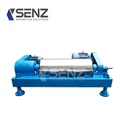

A 2-Phase Decanter Centrifuge is a highly efficient piece of equipment widely used in various industries for separating two immiscible phases, typically a solid and a liquid or two different liquids. As a leading supplier of 2-Phase Decanter Centrifuges, I am delighted to share with you the main components of this remarkable machine and how they work together to achieve optimal separation results.
1. Bowl Assembly
The bowl assembly is the heart of the 2-Phase Decanter Centrifuge. It consists of a cylindrical or conical bowl that rotates at high speeds, typically ranging from 1,500 to 4,500 revolutions per minute (RPM). The high rotational speed generates a strong centrifugal force, which is the driving force behind the separation process.
The bowl is made of high-quality stainless steel or other corrosion-resistant materials to ensure durability and long service life. It is designed to withstand the high centrifugal forces and the abrasive nature of the materials being processed. The inner surface of the bowl may be coated with a special material to reduce friction and improve the separation efficiency.
2. Screw Conveyor
The screw conveyor, also known as the scroll, is located inside the bowl and rotates at a slightly different speed than the bowl. The differential speed between the bowl and the screw conveyor creates a relative motion, which allows the screw conveyor to transport the separated solids towards the discharge end of the bowl.
The screw conveyor is designed with a series of flightings that gradually increase in pitch towards the discharge end. This design helps to compress the solids and reduce the moisture content, resulting in a drier and more compact solid product. The screw conveyor is also equipped with a wear-resistant coating or hard-facing to protect it from the abrasive nature of the solids.
3. Drive System
The drive system is responsible for providing the power to rotate the bowl and the screw conveyor. It typically consists of an electric motor, a gearbox, and a belt or chain drive. The electric motor is the primary source of power and is selected based on the required speed and torque of the centrifuge.
The gearbox is used to adjust the speed and torque of the drive system. It allows the operator to control the differential speed between the bowl and the screw conveyor, which is an important parameter for achieving optimal separation results. The belt or chain drive is used to transmit the power from the motor to the bowl and the screw conveyor.
4. Feed System
The feed system is used to introduce the feed material into the centrifuge. It typically consists of a feed pipe, a feed distributor, and a feed pump. The feed pipe is connected to the feed source and delivers the feed material to the feed distributor.


The feed distributor is located inside the bowl and is designed to evenly distribute the feed material across the cross-section of the bowl. This helps to ensure that the separation process is uniform and efficient. The feed pump is used to provide the necessary pressure to deliver the feed material into the centrifuge.
5. Discharge System
The discharge system is used to remove the separated solids and liquids from the centrifuge. It typically consists of a solids discharge port and a liquid discharge port. The solids discharge port is located at the end of the bowl and is designed to allow the separated solids to be discharged from the centrifuge.
The liquid discharge port is located at the opposite end of the bowl and is designed to allow the separated liquid to be discharged from the centrifuge. The discharge ports may be equipped with valves or other control devices to regulate the flow of the solids and liquids.
6. Control System
The control system is used to monitor and control the operation of the centrifuge. It typically consists of a programmable logic controller (PLC), a human-machine interface (HMI), and various sensors and actuators. The PLC is the central control unit of the centrifuge and is responsible for executing the control programs and algorithms.
The HMI is used to provide the operator with a graphical interface to monitor and control the operation of the centrifuge. It allows the operator to set the operating parameters, such as the speed, torque, and differential speed, and to monitor the status of the centrifuge, such as the temperature, pressure, and vibration.
The sensors and actuators are used to measure the various process parameters and to control the operation of the centrifuge. They include sensors for measuring the temperature, pressure, flow rate, and level of the feed material and the separated solids and liquids, and actuators for controlling the speed, torque, and differential speed of the centrifuge.
7. Lubrication System
The lubrication system is used to provide lubrication to the moving parts of the centrifuge, such as the bearings, gears, and seals. It typically consists of an oil pump, an oil filter, and an oil reservoir. The oil pump is used to circulate the lubricating oil through the moving parts of the centrifuge.
The oil filter is used to remove any contaminants from the lubricating oil, such as dirt, metal particles, and water. The oil reservoir is used to store the lubricating oil and to provide a constant supply of oil to the moving parts of the centrifuge.
8. Cooling System
The cooling system is used to cool the centrifuge and to prevent overheating. It typically consists of a cooling water pump, a heat exchanger, and a cooling water reservoir. The cooling water pump is used to circulate the cooling water through the heat exchanger and the centrifuge.
The heat exchanger is used to transfer the heat from the centrifuge to the cooling water. The cooling water reservoir is used to store the cooling water and to provide a constant supply of water to the cooling system.
Applications of 2-Phase Decanter Centrifuges
2-Phase Decanter Centrifuges are widely used in various industries, including:
- Wastewater Treatment: In wastewater treatment plants, 2-Phase Decanter Centrifuges are used to separate the sludge from the wastewater. The separated sludge can be further processed for disposal or reuse, while the treated water can be discharged into the environment.
- Food and Beverage Industry: In the food and beverage industry, 2-Phase Decanter Centrifuges are used to separate the solids from the liquids in various processes, such as the clarification of fruit juices, the separation of milk and cream, and the recovery of yeast from beer.
- Chemical Industry: In the chemical industry, 2-Phase Decanter Centrifuges are used to separate the solids from the liquids in various chemical processes, such as the separation of catalysts from the reaction mixture, the purification of chemicals, and the recovery of solvents.
- Mining and Minerals Industry: In the mining and minerals industry, 2-Phase Decanter Centrifuges are used to separate the solids from the liquids in various mineral processing operations, such as the separation of coal from the slurry, the separation of minerals from the ore, and the dewatering of tailings.
Related Products
If you are interested in exploring more about centrifuges, we also offer other related products such as the Two Stage Pusher Centrifuge, Dairy Milk Separator Equipment, and Thickening Centrifuge. These products are designed to meet the specific needs of different industries and applications.
Contact for Purchase and Consultation
If you are in the market for a 2-Phase Decanter Centrifuge or have any questions about our products, we encourage you to contact us for a detailed consultation. Our team of experts is ready to assist you in selecting the right centrifuge for your specific application and to provide you with the best possible solution.
References
- Perry, R. H., & Green, D. W. (Eds.). (2008). Perry's Chemical Engineers' Handbook. McGraw-Hill.
- Svarovsky, L. (1990). Solid-Liquid Separation. Butterworth-Heinemann.
- Wakeman, R. J., & Tarleton, E. S. (2005). Solid/Liquid Separation Equipment Scale-Up. Elsevier.