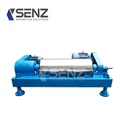

Hey there, fellow farmers! As a supplier of Manure Decanter Centrifuges, I've seen firsthand the amazing economic benefits these machines can bring to a farm. In this blog post, I'm gonna break down why investing in a manure decanter centrifuge is a smart move for your bottom line.
1. Reduced Disposal Costs
One of the most significant economic advantages of using a manure decanter centrifuge is the reduction in disposal costs. Traditional manure management often involves spreading raw manure directly on fields or transporting it to a landfill. Both methods can be costly and have environmental implications.
When you use a manure decanter centrifuge, it separates the manure into solid and liquid components. The solid fraction can be easily composted and used as high - quality organic fertilizer on your own farm or sold to other farmers. This reduces the need for expensive commercial fertilizers. The liquid fraction, which is mostly water, can be treated and reused for irrigation or discharged in an environmentally friendly way.
By diverting manure from landfills and reducing the reliance on commercial fertilizers, you can save a substantial amount of money on disposal fees and fertilizer purchases. For example, a medium - sized farm that spends thousands of dollars each year on fertilizer and manure disposal can significantly cut these costs by implementing a manure decanter centrifuge.
2. Increased Fertilizer Value
The solid fraction separated by the manure decanter centrifuge is rich in nutrients such as nitrogen, phosphorus, and potassium. These nutrients are essential for plant growth. Unlike raw manure, the solid fraction from the centrifuge is more concentrated and easier to handle.
You can use this high - quality organic fertilizer on your fields, which can improve soil structure, water - holding capacity, and overall soil fertility. This, in turn, can lead to higher crop yields. Higher yields mean more produce to sell, which directly translates into increased revenue for your farm.
Moreover, if you have an excess of the solid fertilizer, you can sell it to other farmers in the area. There is a growing demand for organic fertilizers as consumers are becoming more conscious about the environmental impact of conventional farming methods. So, not only are you saving money on your own fertilizer needs, but you also have the potential to generate additional income.
3. Improved Water Management
The liquid fraction separated by the manure decanter centrifuge is mostly water, which can be reused for irrigation purposes. This is a huge advantage, especially in regions where water is scarce or expensive.


By reusing the liquid fraction, you can reduce your water bills and ensure a more sustainable water supply for your crops. Additionally, treating the liquid fraction through the centrifuge process can remove many of the contaminants and pathogens present in raw manure, making it safer for irrigation.
This improved water management can also have a positive impact on the environment. By reducing the amount of water taken from natural sources and minimizing the discharge of contaminated water, you are contributing to the conservation of water resources and the protection of local ecosystems.
4. Energy Savings
Manure decanter centrifuges are designed to be energy - efficient. Compared to some other manure treatment methods, they consume less energy while achieving a high level of separation efficiency.
The energy savings can add up over time, especially for farms that operate the centrifuge on a regular basis. By reducing your energy consumption, you can lower your operating costs and make your farm more environmentally friendly.
5. Versatility and Additional Applications
Our manure decanter centrifuges are not just limited to manure separation. They can also be used for other applications on the farm. For instance, they can be used as a Sludge Dewatering Conveyor, which is useful for dewatering sludge from other processes on the farm.
They can also function as a Gluten Wheat Flour Separator if you are involved in wheat processing. And if you produce soymilk on your farm, our centrifuge can be used as a Soymilk Decanter Centrifuge to separate the solids from the soymilk.
This versatility means that you are getting more value for your money. Instead of buying multiple machines for different tasks, you can use one manure decanter centrifuge for a variety of applications on your farm.
Why Choose Our Manure Decanter Centrifuges?
We understand that investing in a manure decanter centrifuge is a big decision for any farm. That's why we offer high - quality, reliable machines that are built to last. Our centrifuges are designed with the latest technology to ensure maximum efficiency and performance.
We also provide excellent customer service. Our team of experts is always available to answer your questions, provide technical support, and help you with the installation and maintenance of the centrifuge. We want to make sure that you get the most out of your investment and that your farm benefits from the economic advantages of using our manure decanter centrifuge.
Conclusion
In conclusion, using a manure decanter centrifuge on your farm can bring numerous economic benefits. From reducing disposal costs and increasing fertilizer value to improving water management and saving energy, these machines are a smart investment for any farm.
If you're interested in learning more about our manure decanter centrifuges or want to discuss how they can benefit your specific farm, don't hesitate to reach out. We're here to help you make the most of this technology and take your farm to the next level.
References
- Agricultural Economics Research Institute. "Economic Analysis of Manure Management Technologies." 20XX.
- Journal of Sustainable Agriculture. "Benefits of Organic Fertilizers in Modern Farming." Vol. XX, Issue XX, 20XX.
- Water Resources Management Journal. "Water Reuse in Agriculture: A Sustainable Approach." Vol. XX, Issue XX, 20XX.