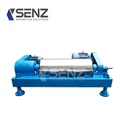

Hey there! As a supplier of Sludge Decanter Centrifuges, I've seen firsthand how crucial it is to optimize the differential speed setting of these machines. In this blog post, I'm gonna share some tips and tricks on how you can do just that.
First off, let's talk about what differential speed is. In a sludge decanter centrifuge, the differential speed refers to the difference in rotational speed between the bowl and the screw conveyor. This speed difference is what allows the centrifuge to separate the solid and liquid components of the sludge. By adjusting the differential speed, you can control the rate at which the solids are discharged from the centrifuge and the dryness of the cake.
Now, why is it so important to optimize the differential speed setting? Well, if the differential speed is too high, the solids may not have enough time to settle properly, resulting in a wetter cake and lower separation efficiency. On the other hand, if the differential speed is too low, the solids may build up in the centrifuge, causing blockages and reducing the machine's performance. So, finding the right balance is key.
So, how do you go about optimizing the differential speed setting? Here are some steps you can follow:
Step 1: Understand Your Sludge
The first step in optimizing the differential speed setting is to understand the characteristics of your sludge. Different types of sludge have different properties, such as particle size, density, and viscosity, which can affect the separation process. For example, sludge with larger particles may require a higher differential speed to ensure proper separation, while sludge with a high viscosity may require a lower differential speed to prevent blockages.
You can perform some tests on your sludge to determine its properties. For example, you can measure the particle size distribution using a particle size analyzer, or you can measure the viscosity using a viscometer. Once you have a better understanding of your sludge, you can start to adjust the differential speed setting accordingly.
Step 2: Start with the Manufacturer's Recommendations
Most sludge decanter centrifuge manufacturers provide recommended differential speed settings based on the type and capacity of the machine. These recommendations are a good starting point, but they may not be optimal for your specific application. So, it's important to test the centrifuge with different differential speed settings to find the best one for your sludge.
Step 3: Conduct a Trial Run
Once you have a starting point for the differential speed setting, it's time to conduct a trial run. Start the centrifuge and gradually increase the differential speed while monitoring the performance of the machine. Pay attention to the following parameters:
- Cake dryness: Measure the moisture content of the cake using a moisture analyzer. A drier cake indicates better separation efficiency.
- Liquid clarity: Observe the clarity of the liquid discharged from the centrifuge. A clearer liquid indicates less solids in the effluent.
- Machine vibration: Excessive vibration can indicate a problem with the centrifuge, such as an imbalance or a blockage.
Based on the results of the trial run, you can adjust the differential speed setting as needed. If the cake is too wet, you may need to increase the differential speed. If the liquid is too cloudy, you may need to decrease the differential speed.
Step 4: Monitor and Adjust Continuously
Optimizing the differential speed setting is not a one-time process. The properties of your sludge may change over time, which can affect the performance of the centrifuge. So, it's important to monitor the performance of the machine regularly and adjust the differential speed setting as needed.
You can use a monitoring system to track the performance of the centrifuge and receive alerts if there are any issues. This can help you catch problems early and prevent costly downtime.
Other Factors to Consider
In addition to the differential speed setting, there are other factors that can affect the performance of a sludge decanter centrifuge. Here are some things to keep in mind:
- Feed rate: The feed rate of the sludge into the centrifuge can affect the separation process. If the feed rate is too high, the centrifuge may not have enough time to separate the solids and liquids properly. On the other hand, if the feed rate is too low, the centrifuge may not be operating at its full capacity.
- Flocculant dosage: Flocculants are chemicals that are added to the sludge to help the solids agglomerate and settle more easily. The dosage of flocculant can affect the performance of the centrifuge. If the dosage is too low, the solids may not agglomerate properly, resulting in a wetter cake. If the dosage is too high, it can increase the cost of the treatment process and may also cause problems with the centrifuge.
- Bowl speed: The bowl speed of the centrifuge can also affect the separation process. A higher bowl speed can increase the centrifugal force, which can improve the separation efficiency. However, a higher bowl speed can also increase the wear and tear on the centrifuge and may require more energy to operate.
Conclusion
Optimizing the differential speed setting of a sludge decanter centrifuge is an important step in ensuring the efficient and effective separation of solids and liquids. By understanding the characteristics of your sludge, starting with the manufacturer's recommendations, conducting a trial run, and monitoring and adjusting continuously, you can find the best differential speed setting for your application.


If you're in the market for a sludge decanter centrifuge or need help optimizing the performance of your existing machine, we're here to help. We offer a wide range of DDGS Dewatering Centrifuges, Separation Decanter Centrifuges, and other centrifuge products to meet your specific needs. Contact us today to learn more about our products and services and to discuss your requirements.
References
- "Sludge Dewatering Handbook" by the Water Environment Federation
- "Centrifugal Separation Technology" by Carl A. Grethlein