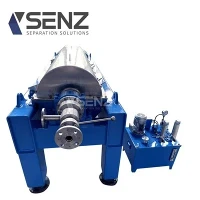

The speed of a 2 - Phase Decanter Centrifuge plays a pivotal role in the separation process. As a leading supplier of 2 - Phase Decanter Centrifuges, I've witnessed firsthand how the rotational speed can significantly impact the efficiency and effectiveness of various separation tasks. In this blog, we'll delve into the science behind the speed of a 2 - Phase Decanter Centrifuge and its influence on the separation process.
Understanding the Basics of a 2 - Phase Decanter Centrifuge
A 2 - Phase Decanter Centrifuge is a device used to separate two immiscible liquids or a liquid and a solid phase. It operates on the principle of centrifugal force, which is generated by the high - speed rotation of the centrifuge bowl. The centrifugal force causes the denser phase to move towards the outer wall of the bowl, while the less dense phase remains closer to the center.
The basic components of a 2 - Phase Decanter Centrifuge include a rotating bowl, a screw conveyor, and a drive system. The screw conveyor is used to transport the separated solids out of the centrifuge, while the liquid phases are discharged through separate outlets.
The Role of Speed in the Separation Process
The speed of a 2 - Phase Decanter Centrifuge is measured in revolutions per minute (RPM). The higher the RPM, the greater the centrifugal force generated. This centrifugal force is crucial for the separation process, as it determines how quickly and effectively the different phases are separated.
Sedimentation and Clarification
In a 2 - Phase Decanter Centrifuge, the speed affects the sedimentation rate of the solids. When the centrifuge operates at a high speed, the centrifugal force causes the solid particles to sediment more rapidly towards the outer wall of the bowl. This results in a more efficient separation of the solid and liquid phases. For example, in a wastewater treatment plant, a high - speed 2 - Phase Decanter Centrifuge can quickly separate the suspended solids from the water, leading to a clearer effluent.
On the other hand, if the speed is too low, the sedimentation rate will be slow, and the separation may not be complete. This can lead to a lower quality of the separated products and may require additional processing steps to achieve the desired level of separation.
Particle Size and Separation Efficiency
The speed of the centrifuge also affects the separation of particles based on their size. Smaller particles require a higher centrifugal force to be separated from the liquid phase. By increasing the speed of the centrifuge, we can increase the centrifugal force and improve the separation of smaller particles.
For instance, in the pharmaceutical industry, where the separation of fine particles is often required, a high - speed 2 - Phase Decanter Centrifuge can be used to achieve a high level of purity in the final product. You can learn more about Centrifuge for The Pharmaceutical Industry on our website.
Phase Separation
In addition to separating solids from liquids, a 2 - Phase Decanter Centrifuge can also be used to separate two immiscible liquids. The speed of the centrifuge affects the interface between the two liquid phases. A higher speed can help to create a sharper interface, resulting in a more efficient separation of the two liquids.
For example, in the oil and gas industry, a 2 - Phase Decanter Centrifuge can be used to separate oil from water. By adjusting the speed of the centrifuge, we can optimize the separation process and maximize the recovery of oil.
Factors Affecting the Optimal Speed
Determining the optimal speed for a 2 - Phase Decanter Centrifuge depends on several factors.
Properties of the Feed Material
The properties of the feed material, such as the density, viscosity, and particle size distribution, play a significant role in determining the optimal speed. For example, if the feed material has a high viscosity, a higher speed may be required to overcome the resistance and achieve effective separation.
Desired Separation Efficiency
The desired level of separation efficiency also affects the optimal speed. If a high level of separation is required, a higher speed may be necessary. However, increasing the speed too much can also lead to increased wear and tear on the centrifuge components and may require more energy consumption.
Capacity Requirements
The capacity requirements of the separation process also influence the optimal speed. If a large volume of material needs to be processed, a higher speed may be needed to ensure that the centrifuge can handle the throughput.
Impact of Speed on Centrifuge Performance
The speed of a 2 - Phase Decanter Centrifuge has a direct impact on its performance.
Throughput
The throughput of a centrifuge is the amount of material that can be processed per unit of time. A higher speed generally allows for a higher throughput, as the separation process is faster. However, there is a limit to how much the speed can be increased, as excessive speed can lead to problems such as vibration and mechanical failure.
Separation Quality
The quality of the separation is also affected by the speed. A higher speed can result in a more complete separation of the phases, leading to a higher - quality product. However, if the speed is too high, it can cause the formation of emulsions or the breakage of particles, which can reduce the separation quality.
Energy Consumption
The speed of the centrifuge is directly related to its energy consumption. A higher speed requires more energy to maintain, which can increase the operating costs. Therefore, it is important to find the optimal speed that balances the separation efficiency and energy consumption.
Applications of 2 - Phase Decanter Centrifuges at Different Speeds
2 - Phase Decanter Centrifuges are used in a wide range of industries, and the optimal speed varies depending on the application.


Wastewater Treatment
In wastewater treatment, a 2 - Phase Decanter Centrifuge can be used to separate the sludge from the water. A medium - to high - speed centrifuge is typically used to achieve a high level of separation efficiency. The separated sludge can then be further processed for disposal or reuse. You can find more information about Chemical Wastewater Separation Centrifuge on our website.
Food and Beverage Industry
In the food and beverage industry, 2 - Phase Decanter Centrifuges are used to separate solids from liquids, such as separating cream from milk or clarifying fruit juices. The speed of the centrifuge is adjusted based on the specific requirements of the product. For example, a lower speed may be used for delicate products to avoid damage to the particles.
Mining and Minerals
In the mining and minerals industry, 2 - Phase Decanter Centrifuges are used to separate valuable minerals from the ore. A high - speed centrifuge is often required to achieve a high - efficiency separation of the fine particles.
Conclusion
The speed of a 2 - Phase Decanter Centrifuge is a critical factor in the separation process. It affects the sedimentation rate, particle size separation, phase separation, and overall performance of the centrifuge. By understanding the relationship between speed and separation, we can optimize the operation of the centrifuge to achieve the best results.
As a supplier of 2 - Phase Decanter Centrifuges, we offer a wide range of models with different speed capabilities to meet the diverse needs of our customers. If you are interested in learning more about our products or have specific separation requirements, we encourage you to contact us for a detailed discussion. Our team of experts is ready to assist you in selecting the right centrifuge and optimizing its performance for your application.
References
- Perry, R. H., & Green, D. W. (2008). Perry's Chemical Engineers' Handbook. McGraw - Hill.
- Svarovsky, L. (2000). Solid - Liquid Separation. Butterworth - Heinemann.