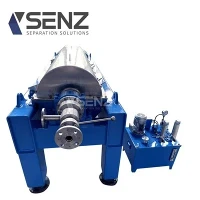

The operation of a 2-Phase Decanter Centrifuge is significantly influenced by the material properties of the substances being processed. Understanding these impacts is crucial for optimizing the centrifuge's performance, ensuring efficiency, and prolonging its lifespan. As a 2-Phase Decanter Centrifuge supplier, I have witnessed firsthand how different material properties can either enhance or impede the centrifuge's operation.
Density and Viscosity
One of the most critical material properties affecting the 2-Phase Decanter Centrifuge operation is density. The centrifuge works on the principle of separating two immiscible liquids or a liquid and a solid based on their density differences. When the density difference between the two phases is large, the separation process is more efficient. The heavier phase migrates to the outer wall of the centrifuge bowl, while the lighter phase remains closer to the center. This allows for easy collection of the two phases through separate outlets.
For instance, in the Wastewater Treatment Centrifuge application, the solid particles in the wastewater are usually denser than the liquid phase. The centrifuge can effectively separate the solids from the water, clarifying the liquid and concentrating the solids for further treatment or disposal. However, if the density difference is small, the separation becomes more challenging, and the centrifuge may require more time or higher rotational speeds to achieve satisfactory results.
Viscosity is another important property. High - viscosity materials can pose significant challenges to the 2-Phase Decanter Centrifuge. Viscous fluids flow more slowly, which can lead to a reduced throughput in the centrifuge. The thick consistency of viscous materials may also cause clogging in the centrifuge channels or the scroll conveyor, which is responsible for transporting the separated solids. This can result in increased wear on the centrifuge components, reduced separation efficiency, and even breakdowns.
On the other hand, low - viscosity materials flow more freely, facilitating a smoother operation of the centrifuge. They can be processed at higher throughputs, and the separation process is generally more efficient. For example, in the Sugarcane Juicer application, the extracted juice has a relatively low viscosity, allowing the centrifuge to quickly separate the juice from the solid pulp.


Particle Size and Shape
The size and shape of the solid particles in a liquid - solid mixture also have a substantial impact on the 2 - Phase Decanter Centrifuge operation. Larger particles are easier to separate from the liquid phase as they are more readily affected by the centrifugal force. The centrifuge can quickly sediment these particles to the bowl wall, where they can be removed by the scroll conveyor.
However, when dealing with fine particles, the separation becomes more difficult. Fine particles tend to remain suspended in the liquid for longer periods due to Brownian motion and other forces. They may also form aggregates or be trapped in the liquid phase, reducing the separation efficiency. In some cases, additional chemicals may be required to flocculate the fine particles, making them larger and easier to separate. For example, in the Retrieval Of Starch in Potatoes, the starch particles are often very fine. The centrifuge needs to operate carefully to ensure efficient separation of the starch from the potato juice.
The shape of the particles can also play a role. Irregularly shaped particles may cause more wear on the centrifuge components compared to spherical particles. They can also get stuck in the centrifuge channels, reducing the flow and causing blockages. Spherical particles, on the other hand, tend to flow more smoothly through the centrifuge, reducing the risk of clogging and wear.
Chemical Composition
The chemical composition of the materials being processed affects the 2 - Phase Decanter Centrifuge operation in several ways. Some chemicals can cause corrosion of the centrifuge components. If the material contains acidic or alkaline substances, the centrifuge parts made of certain metals may be damaged over time. This can lead to leaks, reduced performance, and a shorter lifespan of the equipment.
To combat this, the centrifuge may need to be made of corrosion - resistant materials such as stainless steel or coated with special protective layers. Moreover, the chemical properties of the materials can also affect the separation process. For example, if the materials form emulsions, it becomes more difficult to separate the two phases. Emulsions are stable mixtures of two immiscible liquids where one liquid is dispersed in the other in the form of small droplets. Breaking these emulsions may require the addition of demulsifiers or the use of higher centrifugal forces.
Temperature
Temperature can significantly impact the material properties and, consequently, the 2 - Phase Decanter Centrifuge operation. An increase in temperature generally reduces the viscosity of liquids. As mentioned earlier, lower viscosity promotes better flow and more efficient separation in the centrifuge. However, high temperatures can also cause some materials to undergo chemical reactions or phase changes. For example, if the material contains heat - sensitive substances, high temperatures may cause them to decompose or denature.
On the other hand, low temperatures can increase the viscosity of the materials, making it more difficult for the centrifuge to separate the phases. In some cases, the material may even solidify at low temperatures, causing blockages in the centrifuge. Therefore, it is often necessary to control the temperature of the material before it enters the centrifuge to ensure optimal operation.
Impact on Centrifuge Design and Selection
Given the significant influence of material properties on the 2 - Phase Decanter Centrifuge operation, the design and selection of the centrifuge are crucial. When dealing with materials of high viscosity or small particle size, a centrifuge with a higher rotational speed or a larger bowl diameter may be required to increase the centrifugal force. For corrosive materials, a centrifuge made of corrosion - resistant materials should be chosen.
As a Decanter Centrifuge supplier, we offer a wide range of centrifuge models to suit different material properties and applications. Our High Speed Centrifuge is ideal for separating difficult - to - separate materials, such as those with small density differences or fine particles. Our centrifuge designs are also optimized for different flow rates and throughput requirements, ensuring that our customers can achieve the best possible separation results.
Conclusion
In conclusion, the material properties have a profound impact on the 2 - Phase Decanter Centrifuge operation. Density, viscosity, particle size and shape, chemical composition, and temperature all play important roles in determining the efficiency, throughput, and lifespan of the centrifuge. As a 2 - Phase Decanter Centrifuge supplier, we understand the importance of these factors and are committed to providing our customers with the best - suited centrifuge solutions.
If you are looking for a reliable and efficient 2 - Phase Decanter Centrifuge for your specific material processing needs, we are here to help. Our team of experts can analyze your material properties and recommend the most appropriate centrifuge model. Contact us today to start a discussion about your requirements and explore how our centrifuge solutions can optimize your operations.
References
- Perry, R. H., & Green, D. W. (Eds.). (2008). Perry's Chemical Engineers' Handbook. McGraw - Hill.
- Svarovsky, L. (1990). Solid - Liquid Separation. Butterworth - Heinemann.
- Wakeman, R. J., & Tarleton, E. S. (2005). Solid/Liquid Separation Equipment Scale - Up. Elsevier.