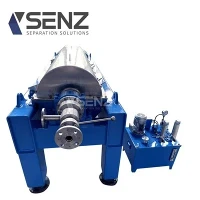

Hey there! As a supplier of Decanter Machines, I've been getting a lot of questions lately about how the feed flow rate affects the separation performance of these machines. So, I thought I'd take a moment to break it down for you in this blog post.
First off, let's talk about what a Decanter Machine actually does. In simple terms, a Decanter Machine is a type of centrifuge that's used to separate solids from liquids. It works by spinning the mixture at high speeds, which causes the heavier solids to settle to the outer edge of the bowl while the lighter liquid stays in the center. The separated solids and liquids are then discharged through different outlets.
Now, the feed flow rate refers to how fast the mixture is being fed into the Decanter Machine. This rate can have a significant impact on the separation performance of the machine, and here's why.
Impact on Separation Efficiency
One of the most important aspects of a Decanter Machine's performance is its separation efficiency. This is basically a measure of how well the machine can separate the solids from the liquids. When the feed flow rate is too high, the mixture doesn't have enough time to be properly separated. The high - speed flow can cause the solids to be carried along with the liquid, resulting in a lower separation efficiency.
For instance, if you're using a Starch Extraction Decanter Centrifuge to separate starch from water, a high feed flow rate might mean that some of the starch particles end up in the water phase. This not only reduces the purity of the starch but also wastes valuable product.
On the other hand, if the feed flow rate is too low, the machine isn't operating at its full capacity. This can lead to longer processing times and increased energy consumption. So, finding the right balance is crucial.
Effect on Solids Dewatering
Another important factor is solids dewatering. The goal of dewatering is to remove as much liquid as possible from the solids. When the feed flow rate is high, the liquid has less time to drain from the solids. As a result, the solids may come out wetter than desired.
Let's say you're using a Protein Centrifuge to separate protein from a liquid solution. A high feed flow rate could prevent the liquid from being effectively squeezed out of the protein solids, leaving you with a protein cake that has a higher moisture content.
Conversely, a lower feed flow rate allows more time for the liquid to drain from the solids, resulting in drier solids. However, too low a flow rate can cause the solids to build up in the machine and may even lead to blockages.
Impact on Liquid Clarity
The clarity of the separated liquid is also affected by the feed flow rate. A high feed flow rate can cause small solid particles to remain suspended in the liquid. This makes the liquid cloudy and may not meet the quality requirements for further processing or disposal.
For example, in an Oilfield Drilling Equipment application, where the Decanter Machine is used to separate drilling mud into solids and a clean liquid phase, a high feed flow rate can result in a liquid phase that still contains a significant amount of fine particles. This can cause problems in the subsequent stages of the drilling process.
A lower feed flow rate gives the machine more time to separate the fine particles from the liquid, resulting in a clearer liquid phase.
Finding the Optimal Feed Flow Rate
So, how do you find the optimal feed flow rate for your Decanter Machine? Well, it depends on several factors, such as the type of mixture you're separating, the properties of the solids and liquids, and the specific requirements of your process.
In general, it's a good idea to start with a relatively low feed flow rate and gradually increase it while monitoring the separation performance. You can look at indicators like the moisture content of the solids, the clarity of the liquid, and the overall separation efficiency.


Some Decanter Machines come with advanced control systems that can automatically adjust the feed flow rate based on the real - time performance of the machine. These systems can be really helpful in maintaining optimal separation performance.
Different Applications and Feed Flow Rate
Let's take a look at how the feed flow rate varies in different applications.
In a Small Decanter Centrifuge used for laboratory or small - scale production, the feed flow rate is usually much lower compared to industrial - scale machines. This is because the smaller size of the machine can handle less volume at a time.
In an industrial setting, such as a large - scale food processing plant or a wastewater treatment facility, the feed flow rate needs to be carefully optimized to ensure maximum productivity. For example, in a wastewater treatment plant using a Decanter Machine to separate sludge from water, a proper feed flow rate can significantly improve the efficiency of the treatment process and reduce operating costs.
In some international markets, like those where Decantador is commonly used, local regulations and specific process requirements may also influence the choice of feed flow rate.
Conclusion
In conclusion, the feed flow rate plays a crucial role in the separation performance of a Decanter Machine. It affects the separation efficiency, solids dewatering, and liquid clarity. Finding the right feed flow rate is essential for achieving optimal results in your separation process, whether it's in starch extraction, protein separation, oilfield drilling, or any other application.
If you're in the market for a Decanter Machine or need more advice on optimizing the feed flow rate for your existing machine, don't hesitate to reach out. We're here to help you get the most out of your separation process.
References
- Perry, R. H., & Green, D. W. (Eds.). (2008). Perry's Chemical Engineers' Handbook. McGraw - Hill.
- Coulson, J. M., Richardson, J. F., Backhurst, J. R., & Harker, J. H. (1999). Chemical Engineering Volume 2: Particle Technology and Separation Processes. Butterworth - Heinemann.