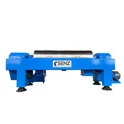

Hey there! As a supplier of 3 - Phase Decanter Centrifuges, I've seen firsthand how crucial particle size can be when it comes to the separation performance of these awesome machines. In this blog, I'll walk you through the ins and outs of how particle size affects the separation process in a 3 - Phase Decanter Centrifuge.
Understanding the Basics of a 3 - Phase Decanter Centrifuge
First off, let's quickly go over what a 3 - Phase Decanter Centrifuge does. It's a piece of equipment that separates a mixture into three distinct phases: a solid phase, a light liquid phase (usually oil), and a heavy liquid phase (usually water). This separation is achieved through the use of centrifugal force. The centrifuge spins at high speeds, causing the different components of the mixture to separate based on their density.
The Three - Phase Separation Decanter is a key product in our lineup. It's designed to handle a wide range of applications, from industrial waste treatment to food processing. The 3 Phase Centrifuge is also a popular choice, especially for those who need a reliable and efficient separation solution. And if you're dealing with industrial waste oil, our Industrial Waste Oil Centrifuge is the way to go.
How Particle Size Comes into Play
Now, let's get into how particle size affects the separation performance. When it comes to the solid phase, the size of the particles in the mixture can have a huge impact on how well the centrifuge can separate them from the liquid phases.
Small Particles
Small particles can be a real pain in the neck when it comes to separation. They tend to stay suspended in the liquid phases, making it difficult for the centrifuge to separate them out. This is because the centrifugal force acting on small particles is relatively weak compared to larger particles. As a result, small particles may not settle at the bottom of the centrifuge bowl as quickly or as effectively.
In some cases, small particles can even form a stable emulsion with the liquid phases. An emulsion is a mixture of two immiscible liquids (like oil and water) where one liquid is dispersed in the other in the form of tiny droplets. When small particles are present, they can act as stabilizers for these emulsions, making it even harder to separate the phases.
Large Particles
On the other hand, large particles are generally easier to separate. The centrifugal force acting on large particles is stronger, which means they settle at the bottom of the centrifuge bowl more quickly. This makes it easier for the centrifuge to separate the solid phase from the liquid phases.
However, large particles can also cause problems. If the particles are too large, they can clog the centrifuge's discharge ports or damage the internal components of the machine. This can lead to reduced separation performance and increased maintenance costs.
Optimal Particle Size
So, what's the optimal particle size for separation in a 3 - Phase Decanter Centrifuge? Well, it depends on a few factors, including the type of mixture you're separating, the design of the centrifuge, and the desired separation efficiency.
In general, a particle size range of around 10 - 100 microns is considered ideal for most applications. Particles within this range are large enough to be easily separated by the centrifuge, but small enough to avoid clogging or damaging the machine.
Impact on Separation Efficiency
The particle size also has a direct impact on the separation efficiency of the centrifuge. Separation efficiency is a measure of how well the centrifuge can separate the different phases of the mixture.
When the particle size is within the optimal range, the centrifuge can achieve high separation efficiency. This means that a greater percentage of the solid phase is separated from the liquid phases, and the resulting products are of higher quality.
However, if the particle size is too small or too large, the separation efficiency can decrease. Small particles may not be separated effectively, leading to a higher concentration of solids in the liquid phases. Large particles, on the other hand, can cause problems with the centrifuge's operation, resulting in a lower separation efficiency.


Other Factors to Consider
While particle size is an important factor, it's not the only one that affects the separation performance of a 3 - Phase Decanter Centrifuge. Other factors include the density of the particles and the liquid phases, the viscosity of the mixture, and the rotational speed of the centrifuge.
The density of the particles and the liquid phases determines how quickly they separate under the influence of centrifugal force. Particles with a higher density will settle more quickly than those with a lower density. Similarly, liquids with a higher density will sink to the bottom of the centrifuge bowl, while liquids with a lower density will float to the top.
The viscosity of the mixture also plays a role. A more viscous mixture will flow more slowly, which can make it more difficult for the centrifuge to separate the phases. In some cases, it may be necessary to add a chemical additive to reduce the viscosity of the mixture and improve the separation performance.
The rotational speed of the centrifuge is another important factor. A higher rotational speed will generate a stronger centrifugal force, which can improve the separation efficiency. However, increasing the rotational speed also increases the wear and tear on the centrifuge, so it's important to find the right balance.
Conclusion
In conclusion, particle size is a critical factor that affects the separation performance of a 3 - Phase Decanter Centrifuge. Small particles can be difficult to separate and may form emulsions, while large particles can cause clogging and damage to the machine. The optimal particle size for separation is typically in the range of 10 - 100 microns.
If you're in the market for a 3 - Phase Decanter Centrifuge, it's important to consider the particle size of the mixture you'll be separating. Our team of experts can help you choose the right centrifuge for your specific application and provide you with the support you need to ensure optimal performance.
If you're interested in learning more about our 3 - Phase Decanter Centrifuges or have any questions about how particle size affects separation performance, don't hesitate to get in touch. We're here to help you find the best solution for your needs.
References
- Perry, R. H., & Green, D. W. (2008). Perry's Chemical Engineers' Handbook. McGraw - Hill.
- Svarovsky, L. (2000). Solid - Liquid Separation. Butterworth - Heinemann.