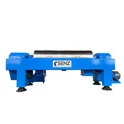

In the realm of industrial separation processes, the 3 - Phase Decanter Centrifuge stands as a remarkable piece of equipment. As a trusted supplier of 3 - Phase Decanter Centrifuges, I am often asked whether these machines can handle high - viscosity materials. This question is crucial for industries dealing with substances that have a thick and sticky consistency, such as certain oils, sludges, and pastes.
Understanding High - Viscosity Materials
High - viscosity materials are characterized by their resistance to flow. Viscosity is a measure of a fluid's internal resistance to deformation, and materials with high viscosity flow very slowly. For example, honey has a much higher viscosity than water. In industrial applications, high - viscosity materials can include heavy oils, bitumen, and some types of polymer solutions. These materials pose unique challenges in separation processes due to their thick nature, which can impede the movement of particles and the separation of different phases.
How a 3 - Phase Decanter Centrifuge Works
Before delving into whether a 3 - Phase Decanter Centrifuge can handle high - viscosity materials, it's essential to understand its basic working principle. A 3 - Phase Decanter Centrifuge is designed to separate a mixture into three distinct phases: a solid phase, a light liquid phase, and a heavy liquid phase. It operates on the principle of centrifugal force. When the mixture is fed into the centrifuge, it rotates at high speeds, causing the denser components to move towards the outer wall of the centrifuge bowl, while the lighter components remain closer to the center.
The centrifuge consists of a rotating bowl and a screw conveyor. The screw conveyor rotates at a slightly different speed than the bowl, which helps to transport the separated solid phase towards the discharge end of the centrifuge. The light and heavy liquid phases are then discharged through separate outlets.
Challenges of Handling High - Viscosity Materials
Handling high - viscosity materials in a 3 - Phase Decanter Centrifuge presents several challenges. Firstly, the high viscosity can make it difficult for the centrifuge to achieve efficient separation. The thick consistency of the material can prevent the particles from settling properly, leading to incomplete separation of the phases. Additionally, the high - viscosity material can cause increased wear and tear on the centrifuge components, such as the screw conveyor and the bowl. This can result in reduced performance and a shorter lifespan of the equipment.
Another challenge is the potential for clogging. High - viscosity materials are more likely to stick to the walls of the centrifuge bowl and the screw conveyor, which can lead to blockages and disrupt the normal operation of the centrifuge. This can require frequent maintenance and cleaning, which can be time - consuming and costly.
Can a 3 - Phase Decanter Centrifuge Handle High - Viscosity Materials?
The answer is yes, but with certain considerations. Modern 3 - Phase Decanter Centrifuges are designed with features that enable them to handle high - viscosity materials more effectively. For example, some centrifuges are equipped with a larger diameter bowl, which provides more space for the separation process and allows the high - viscosity material to flow more freely. Additionally, the screw conveyor can be designed with a special profile to improve the transport of the solid phase and reduce the risk of clogging.
Some centrifuges also have adjustable speed settings, which can be optimized for different types of high - viscosity materials. By adjusting the speed of the centrifuge, the operator can control the centrifugal force and ensure that the separation process is as efficient as possible.


In addition to the design features of the centrifuge itself, proper pre - treatment of the high - viscosity material can also improve the performance of the centrifuge. For example, heating the material can reduce its viscosity, making it easier to separate. Chemical additives can also be used to modify the properties of the material and improve the separation efficiency.
Applications of 3 - Phase Decanter Centrifuges in Handling High - Viscosity Materials
There are several industries where 3 - Phase Decanter Centrifuges are used to handle high - viscosity materials. One such industry is the oil extraction industry. Horizontal Separation Equipment Olive Avocado Oil Extraction Machine is an example of a centrifuge that is used to extract oil from olives and avocados. These fruits contain high - viscosity oils, and the 3 - Phase Decanter Centrifuge is able to separate the oil from the solid and liquid phases efficiently.
Another industry is the palm oil industry. Avocado And Palm Oil Extraction Centrifuge is specifically designed to handle the high - viscosity palm oil. The centrifuge can separate the palm oil from the other components of the palm fruit, such as the kernel and the fiber.
In the wastewater treatment industry, 3 - Phase Decanter Centrifuges are used to separate sludge from water. The sludge often has a high viscosity, and the centrifuge can effectively separate the solid sludge from the liquid phase. Three - Phase Separation Decanter is a type of centrifuge that is commonly used in this application.
Factors to Consider When Using a 3 - Phase Decanter Centrifuge for High - Viscosity Materials
When using a 3 - Phase Decanter Centrifuge to handle high - viscosity materials, several factors need to be considered. Firstly, the viscosity of the material should be accurately measured. This will help to determine the appropriate settings for the centrifuge, such as the speed and the feed rate.
The temperature of the material can also have a significant impact on the performance of the centrifuge. As mentioned earlier, heating the material can reduce its viscosity and improve the separation efficiency. Therefore, it's important to control the temperature of the material during the separation process.
The particle size and distribution of the solid phase in the material are also important factors. If the particles are too large or too unevenly distributed, it can affect the separation process. In some cases, pre - treatment of the material, such as grinding or sieving, may be necessary to ensure that the particles are of an appropriate size.
Conclusion
In conclusion, a 3 - Phase Decanter Centrifuge can handle high - viscosity materials, but it requires careful consideration of several factors. With the right design features, proper pre - treatment of the material, and appropriate operating conditions, the centrifuge can achieve efficient separation of high - viscosity materials.
If you are in an industry that deals with high - viscosity materials and are looking for a reliable 3 - Phase Decanter Centrifuge, we are here to help. Our team of experts can provide you with the necessary guidance and support to select the right centrifuge for your specific application. Contact us to start a procurement discussion and find the best solution for your separation needs.
References
- Perry, R. H., & Green, D. W. (1997). Perry's Chemical Engineers' Handbook. McGraw - Hill.
- Separation Science and Technology: Principles, Methods, and Applications. (2007). Wiley - VCH.
- Industrial Centrifugal Separation: A Practical Approach. (2004). Butterworth - Heinemann.