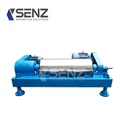

Hey there! As a supplier of sewage decanter centrifuges, I've seen firsthand how crucial the density difference between solids and liquids in sewage is for the separation process. In this blog, I'll break down how this density disparity impacts the separation in a sewage decanter centrifuge and why it matters for your wastewater treatment needs.
Let's start with the basics. A sewage decanter centrifuge is a piece of equipment that uses centrifugal force to separate solids from liquids in sewage. It works by spinning the sewage at high speeds, causing the denser solids to settle to the outer edge of the centrifuge while the lighter liquids stay closer to the center. This separation is essential for treating sewage effectively, as it helps remove contaminants and reduce the volume of waste.
Now, let's talk about density. Density is a measure of how much mass is contained in a given volume. In sewage, solids typically have a higher density than liquids because they are made up of heavier materials like sludge, dirt, and debris. Liquids, on the other hand, are mainly water and have a lower density. This density difference is what allows the centrifuge to separate the two phases.


When sewage enters the decanter centrifuge, it is fed into a rotating bowl. As the bowl spins, the centrifugal force pushes the solids towards the outer wall of the bowl, where they form a layer of sediment. The liquids, meanwhile, are forced towards the center of the bowl and are discharged through an outlet. The key here is that the greater the density difference between the solids and liquids, the more efficiently the centrifuge can separate them.
For example, if the sewage contains a high proportion of heavy solids, such as sand or gravel, the density difference between the solids and liquids will be significant. This means that the solids will settle quickly and easily in the centrifuge, resulting in a more effective separation. On the other hand, if the sewage contains a lot of fine particles or colloids, the density difference may be smaller, making it more challenging for the centrifuge to separate the solids from the liquids.
Another factor that can affect the separation process is the viscosity of the sewage. Viscosity is a measure of a fluid's resistance to flow. If the sewage is very viscous, it can be more difficult for the solids to settle in the centrifuge, even if there is a significant density difference. This is because the viscous fluid can trap the solids and prevent them from moving towards the outer wall of the bowl.
To overcome this issue, some sewage decanter centrifuges are equipped with additional features, such as a scroll conveyor or a flocculant dosing system. A scroll conveyor is a rotating screw that helps move the solids towards the outlet of the centrifuge, while a flocculant dosing system adds chemicals to the sewage to help the fine particles clump together and form larger, more easily separable solids.
So, why does all of this matter for your wastewater treatment needs? Well, the efficiency of the separation process in a sewage decanter centrifuge can have a significant impact on the overall performance of your wastewater treatment system. If the centrifuge is not able to separate the solids from the liquids effectively, it can lead to a buildup of sludge in the system, which can cause blockages and reduce the efficiency of other treatment processes.
In addition, a more efficient separation process can help reduce the volume of waste that needs to be disposed of, which can save you money on disposal costs. By removing as much solid material as possible from the sewage, you can also improve the quality of the treated water, making it safer to discharge into the environment.
As a supplier of sewage decanter centrifuges, we understand the importance of providing our customers with high-quality equipment that is designed to handle a wide range of sewage types and conditions. Our centrifuges are built with the latest technology and features to ensure maximum efficiency and reliability, and we offer a range of models to suit different applications and budgets.
If you're in the market for a sewage decanter centrifuge, we'd love to hear from you. Whether you're looking for a Slurry Dewatering Centrifuge, a Mud Centrifuge, or an Oilfield Drilling Equipment, we have the expertise and experience to help you find the right solution for your needs.
Contact us today to learn more about our products and services, and to schedule a consultation with one of our experts. We look forward to helping you improve the efficiency and effectiveness of your wastewater treatment system.
References
- "Centrifugal Separation Technology in Wastewater Treatment." Journal of Environmental Science and Technology.
- "The Impact of Density and Viscosity on Centrifugal Separation Processes." Chemical Engineering Journal.
- "Advanced Wastewater Treatment: Principles and Applications." McGraw-Hill Education.