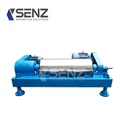

Hey there! As a supplier of the Gluten Wheat Flour Separator, I often get asked if our machine can handle wheat flour with different particle size distributions. Well, let's dig into this topic and find out.
First off, what's a Gluten Wheat Flour Separator? It's a nifty piece of equipment designed to separate gluten from wheat flour. You can check out more about it Gluten Wheat Flour Separator. The basic principle behind it is to use certain physical properties of gluten and wheat flour to separate them. Gluten has different characteristics like elasticity and solubility compared to the other components in wheat flour, and the separator exploits these differences.
Now, when it comes to wheat flour with different particle size distributions, things get a bit more interesting. Wheat flour can vary in particle size depending on how it's milled. Coarse flour has larger particles, while fine flour has smaller ones. And this variation can have an impact on the separation process.
For coarse - grained wheat flour, the larger particles might present some challenges. The separator needs to be able to break down the structure of the flour to access the gluten. But on the flip side, the larger size can also make it easier in some ways. The separator can use mechanical forces more effectively to separate the gluten from the coarser particles. Our Gluten Wheat Flour Separator is equipped with adjustable settings. We can increase the mechanical agitation or adjust the flow rate to ensure that the gluten is properly separated from the coarse flour.
On the other hand, fine - grained wheat flour has its own set of issues. The smaller particles are more likely to clump together, which can make it difficult for the separator to distinguish between the gluten and the other components. However, our separator has advanced filtration systems. These filters are designed to capture the gluten while allowing the fine flour particles to pass through. We can also adjust the pressure and speed of the separator to optimize the separation process for fine flour.
Let's talk about the science behind it. Gluten is a complex protein matrix in wheat flour. When the wheat flour is mixed with water, the gluten forms a sticky, elastic mass. The separator uses a combination of centrifugal force, mechanical agitation, and filtration to separate this gluten mass from the rest of the flour. The centrifugal force helps to separate the heavier gluten particles from the lighter flour particles. The mechanical agitation breaks up the flour structure and releases the gluten. And the filtration system ensures that the gluten is collected and the flour is separated out.
In real - world applications, we've seen that our Gluten Wheat Flour Separator can handle a wide range of particle size distributions. We've worked with bakeries that use different types of wheat flour, from the coarsest whole - wheat flour to the finest pastry flour. In each case, we've been able to adjust the settings of the separator to achieve an efficient separation.
But it's not just about separating gluten from wheat flour. Our separator is also a versatile machine. It shares some similarities with other equipment in our product line, like the Sunflower Seed Oil Decanter Centrifuge. Both use centrifugal force to separate different components. In the case of the sunflower seed oil decanter centrifuge, it separates the oil from the sunflower seeds. And just like our Gluten Wheat Flour Separator, it can be adjusted to handle different types of sunflower seeds with varying particle sizes.
Another related application is Potato Starch Extraction. Similar separation principles are at play here. The machine needs to separate the starch from the potato pulp. Again, the ability to adjust the settings according to the particle size distribution of the potato pulp is crucial.
Now, you might be wondering about the efficiency of our Gluten Wheat Flour Separator. Well, we've conducted numerous tests. We measure the amount of gluten recovered and the purity of the separated gluten. In most cases, we're able to achieve a high recovery rate of gluten, even with different particle size distributions. The purity of the separated gluten is also very high, which is great news for bakeries and other food manufacturers.
One of the key features of our separator is its easy - to - use interface. You don't need to be a technical expert to operate it. The control panel allows you to adjust all the important parameters like speed, pressure, and flow rate. And if you run into any issues, our customer support team is always ready to help.
We also offer customization options. If you have specific requirements for separating gluten from wheat flour with a particular particle size distribution, we can modify the separator to meet your needs. This flexibility is what sets us apart from other suppliers.
So, to answer the question, yes, our Gluten Wheat Flour Separator can be used for separating gluten from wheat flour with different particle size distributions. It's a reliable, efficient, and versatile machine that can adapt to various situations.
If you're in the market for a Gluten Wheat Flour Separator or have any questions about how it can work for your specific needs, don't hesitate to reach out. We're here to help you make the best choice for your business. Whether you're a small - scale bakery or a large - scale food manufacturer, we have the solution for you.
Let's work together to improve your gluten separation process and take your business to the next level. Contact us today to start the conversation about purchasing and to get more detailed information.


References
- Various industry research on gluten separation techniques
- In - house testing reports on the performance of the Gluten Wheat Flour Separator