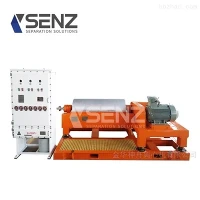
What is the rotational speed of a 3 - Phase Decanter Centrifuge?
Hey there! As a supplier of 3 - Phase Decanter Centrifuges, I often get asked about the rotational speed of these machines. So, let's dive right in and break it down.
First off, what exactly is a 3 - Phase Decanter Centrifuge? Well, it's a powerful piece of equipment used in various industries to separate different phases of a mixture, like solids, liquids, and sometimes even a third phase. It's super handy in things like Industrial Waste Oil Centrifuge applications, where you need to separate oil, water, and solids from waste oil.
Now, the rotational speed of a 3 - Phase Decanter Centrifuge is a crucial factor. It determines how effectively the centrifuge can separate the different phases. The higher the rotational speed, the stronger the centrifugal force, which helps in better separation.
But how do we measure this rotational speed? Usually, it's measured in revolutions per minute (RPM). Different models of 3 - Phase Decanter Centrifuges have different RPM ranges. Some smaller, less powerful models might have a rotational speed of around 2000 - 3000 RPM. These are often used in smaller - scale operations or in applications where the separation requirements aren't too demanding.
On the other hand, larger and more industrial - grade 3 - Phase Decanter Centrifuges can reach rotational speeds of up to 5000 RPM or even higher. For example, in Avocado And Palm Oil Extraction Centrifuge processes, high - speed centrifuges are needed to efficiently separate the oil from the pulp and other components.
The choice of rotational speed depends on several factors. One of the main factors is the type of mixture you're trying to separate. If the mixture has a high density difference between the phases, you might not need a very high rotational speed. For instance, if you're separating a mixture of sand and water, a relatively lower RPM might be sufficient.
However, if the phases have a very similar density, like in the case of some emulsions, a higher rotational speed is required to break the emulsion and separate the phases effectively.
Another factor is the viscosity of the mixture. Viscous mixtures require more energy to separate, so a higher rotational speed might be necessary. For example, in Olive Oil Decanter Centrifuge applications, the olive oil and water mixture can be quite viscous, and a high - speed centrifuge helps in getting a better separation.
The throughput of the centrifuge also plays a role in determining the rotational speed. If you need to process a large volume of the mixture in a short time, you might need a higher rotational speed to maintain the efficiency of the separation.
But it's not just about going for the highest RPM possible. There are some drawbacks to very high rotational speeds. For one, it can increase the wear and tear on the centrifuge components. The bearings, the bowl, and other parts will experience more stress at higher speeds, which can lead to more frequent maintenance and replacement.
Also, very high - speed centrifuges can generate a lot of heat. This heat can affect the quality of the separated products, especially if they are heat - sensitive. For example, in some food - grade applications, excessive heat can damage the flavor and nutritional value of the products.
So, as a supplier, we work closely with our customers to determine the right rotational speed for their specific applications. We take into account all the factors I mentioned above and provide them with a centrifuge that meets their needs.
If you're in the market for a 3 - Phase Decanter Centrifuge, it's important to do your research. Look at the different models available and understand their capabilities. Consider your specific requirements, such as the type of mixture, the throughput, and the quality of separation you need.
We're here to help you make the right choice. Whether you're in the industrial waste oil industry, the oil extraction business, or any other field that requires phase separation, we can provide you with a 3 - Phase Decanter Centrifuge that's just right for you.
If you have any questions or want to discuss your requirements further, don't hesitate to reach out. We're always happy to have a chat and help you find the best solution for your business.
In conclusion, the rotational speed of a 3 - Phase Decanter Centrifuge is a critical parameter that affects its performance. By understanding the factors that influence the rotational speed and working with a reliable supplier, you can ensure that you get a centrifuge that meets your needs and helps you achieve efficient phase separation.
References


- General knowledge of centrifuge technology and industry standards
So, if you're interested in purchasing a 3 - Phase Decanter Centrifuge, just drop us a line and let's start the conversation about how we can meet your separation needs.