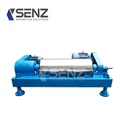
Hey there! As a supplier of Yeast Separators, I often get asked about the role of filters in these machines. So, I figured it'd be cool to dive into this topic and give you all the details.
First off, let's talk about what a yeast separator is. It's a crucial piece of equipment in the food and beverage industry, especially in brewing, baking, and winemaking. Its main job is to separate yeast cells from the liquid medium they're in. This helps in getting a pure product, whether it's beer, wine, or just isolated yeast for baking.
Now, let's get to the stars of the show - the filters. Filters in a yeast separator play a bunch of super important roles.
1. Solid-Liquid Separation
The most obvious role of filters in a yeast separator is to carry out solid-liquid separation. Yeast cells are the solids here, and the liquid can be things like fermentation broth, wort (in brewing), or grape juice (in winemaking). The filter acts as a barrier that allows the liquid to pass through while retaining the yeast cells.


Picture it like a super fine sieve. You know how you use a sieve in the kitchen to drain pasta? Well, the filter in a yeast separator works on a similar principle, but on a much smaller and more precise scale. It keeps the yeast from flowing out with the liquid, ensuring that you get a yeast-free liquid product or a concentrated yeast slurry.
2. Purification
Filters also help in purifying the yeast and the liquid. In a fermentation process, there can be all sorts of unwanted particles floating around, like debris, bacteria, and other contaminants. The filter traps these unwanted elements along with the yeast cells, depending on its pore size.
For instance, if we're making beer, we don't want any mold or wild bacteria in the final product. The filter in the yeast separator helps in removing these potential spoilers, making the beer cleaner and better in quality. At the same time, if we're collecting yeast for future use, having a clean batch of yeast is essential for consistent fermentation results.
3. Concentration
Another big deal is the ability to concentrate the yeast. By separating the liquid from the yeast, the filter helps in increasing the yeast density in the remaining slurry. This concentrated yeast can then be reused for multiple purposes. In baking, it can be added to dough to make it rise properly. In brewing, it can kickstart a new fermentation batch.
The higher the concentration of yeast, the more efficient it is for these processes. It saves time and resources because you don't have to use as much of the yeast slurry to achieve the desired fermentation.
4. Controlling Flow Rate
Filters in yeast separators can also control the flow rate of the liquid passing through. Different applications require different flow rates. For example, in a high-volume industrial brewing operation, a faster flow rate might be needed to keep up with production demands. On the other hand, in a small-scale winery, a slower flow rate could be preferable to ensure better separation and purification.
By choosing the right type of filter with a specific pore size and structure, we can fine-tune the flow rate according to the requirements of the process.
Types of Filters Used in Yeast Separators
There are several types of filters commonly used in yeast separators, each with its own pros and cons.
Screen Filters
Screen filters are one of the simplest types. They're made up of a mesh-like material with uniform holes. These filters are great for separating larger particles and can handle relatively high flow rates. However, they might not be as effective at removing very fine contaminants.
Membrane Filters
Membrane filters are a bit more high-tech. They have extremely small pores that can trap even the tiniest bacteria and particles. This makes them ideal for applications where high levels of purification are required. But they tend to have lower flow rates and can get clogged more easily, so they need to be replaced or cleaned more frequently.
Depth Filters
Depth filters are designed to trap particles within their porous structure. They can handle a wide range of particle sizes and are quite good at removing a variety of contaminants. They're also less likely to clog compared to membrane filters because the particles are distributed throughout the filter media rather than just on the surface.
Our Yeast Separators and Filter Tech
As a supplier, we're always on top of the latest filter technologies for our yeast separators. We use high-quality filters in our machines to ensure the best performance. Whether you need a separator for a small craft brewery or a large industrial winery, we've got you covered.
Our yeast separators are designed to be highly efficient and reliable. The filters we use are carefully selected to match the specific requirements of each application. We can also customize the separator and its filter system according to your unique needs.
Other Related Centrifuges
If you're interested in other types of centrifuges, we've got some great options too. Check out our Palm Oil Clarifier Decanter Centrifuge, which is perfect for separating solids from palm oil. It uses advanced centrifuge technology to ensure a high-quality oil product.
We also have the Manure Decanter Centrifuge for separating solids from manure. This can be super useful for agricultural businesses looking to manage their waste more effectively.
And for those in the waste management industry, our Waste Dewatering centrifuge is a great solution. It helps in reducing the volume of waste by removing water, making it easier and more cost - effective to dispose of.
Time to Talk Business!
If you're in the market for a yeast separator or any of our other centrifuge products, I'd love to have a chat with you. We can discuss your specific needs, the right filter options for you, and how our machines can fit into your production process. Don't hesitate to reach out for a quote or more information. Let's work together to find the perfect solution for your business.
References
- "Centrifuge Technology Handbook"
- "Food and Beverage Processing Equipment: Principles and Applications"
- Industry white papers on yeast separation and filtration.