
As a supplier of Sludge Decanter Centrifuges, I've witnessed firsthand the critical role these machines play in various industries, from wastewater treatment to oil and gas. One of the most frequently asked questions we encounter is about the influence of sludge flow rate on the separation process in a decanter centrifuge. In this blog post, I'll delve into this topic, exploring how the flow rate affects the efficiency and effectiveness of the separation process.
Understanding the Decanter Centrifuge
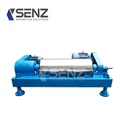
Before we discuss the impact of sludge flow rate, let's briefly review how a decanter centrifuge works. A decanter centrifuge is a continuous - flow device that uses centrifugal force to separate solid particles from a liquid phase. It consists of a rotating bowl and a screw conveyor. The sludge is fed into the centrifuge through a feed pipe, and as the bowl rotates at high speed, the centrifugal force causes the heavier solid particles to settle on the bowl wall, while the lighter liquid phase forms an inner layer. The screw conveyor then moves the settled solids towards the discharge end of the centrifuge, while the clarified liquid is discharged through the other end.
Influence of Sludge Flow Rate on Separation Efficiency
Solids Capture Efficiency
The solids capture efficiency is a key performance indicator of a decanter centrifuge. It refers to the percentage of solid particles in the feed sludge that are successfully separated and removed from the liquid phase. The sludge flow rate has a significant impact on solids capture efficiency.


When the sludge flow rate is too high, the residence time of the sludge in the centrifuge is reduced. The centrifugal force needs a certain amount of time to act on the solid particles to make them settle on the bowl wall. If the sludge passes through the centrifuge too quickly, many solid particles may not have enough time to settle, resulting in a lower solids capture efficiency. As a result, more solid particles will remain in the discharged liquid, leading to a higher turbidity of the effluent.
On the other hand, if the sludge flow rate is too low, although the solids capture efficiency may be high, the overall throughput of the centrifuge is reduced. This means that the centrifuge is not being utilized to its full capacity, which can increase the operating cost per unit of treated sludge. Therefore, there is an optimal sludge flow rate that can achieve the best balance between solids capture efficiency and throughput.
Liquid Clarity
The clarity of the separated liquid is another important aspect affected by the sludge flow rate. A high sludge flow rate can cause turbulence inside the centrifuge. This turbulence can disrupt the settling process of solid particles and cause the re - suspension of already settled solids. As a result, the liquid discharged from the centrifuge will have a higher concentration of fine solid particles, reducing its clarity.
In contrast, a lower flow rate generally leads to better liquid clarity because there is less turbulence and more time for the solid particles to settle. However, as mentioned before, an extremely low flow rate is not practical from an economic perspective.
Impact on Centrifuge Wear and Tear
The sludge flow rate also affects the wear and tear of the decanter centrifuge components. A high sludge flow rate means that more sludge is passing through the centrifuge in a given time. This can increase the abrasion on the screw conveyor and the bowl wall. The solid particles in the sludge act as abrasive materials, and the higher the flow rate, the more intense the abrasion.
Over time, excessive wear can lead to damage of the centrifuge components, such as the screw conveyor blades and the bowl surface. This not only increases the maintenance cost but also reduces the lifespan of the centrifuge. Therefore, operating the centrifuge at an appropriate sludge flow rate can help to minimize wear and tear and extend the service life of the equipment.
Determining the Optimal Sludge Flow Rate
Determining the optimal sludge flow rate for a decanter centrifuge depends on several factors, including the characteristics of the sludge (such as particle size distribution, solid concentration, and viscosity), the design parameters of the centrifuge (such as bowl diameter, length, and rotation speed), and the specific requirements of the separation process (such as the desired solids capture efficiency and liquid clarity).
In general, it is recommended to conduct pilot tests using a small - scale centrifuge to determine the optimal flow rate for a particular sludge. During the pilot tests, different flow rates can be applied, and the separation performance (solids capture efficiency, liquid clarity) can be measured. Based on the test results, the optimal flow rate can be identified.
Our Products and Solutions
As a leading supplier of Sludge Decanter Centrifuges, we offer a wide range of products suitable for different applications. Our Solids Control Centrifuge is designed to effectively separate solid particles from drilling fluids in the oil and gas industry, ensuring high - quality solids control. For the coal tar industry, our Coal Tar Decanter Centrifuge can efficiently separate coal tar from impurities, improving the quality of the final product. Additionally, our Oil Water Separator is capable of separating oil from water, which is crucial for environmental protection and resource recovery.
We also provide professional technical support to help our customers determine the optimal operating parameters, including the sludge flow rate, for their specific applications. Our experienced engineers can assist in conducting on - site tests and analyzing the test results to ensure that the centrifuge operates at its best performance.
Conclusion
The sludge flow rate has a profound influence on the separation process in a decanter centrifuge. It affects the solids capture efficiency, liquid clarity, and the wear and tear of the centrifuge components. Finding the optimal sludge flow rate is crucial for achieving high - quality separation results and cost - effective operation.
If you are looking for a reliable Sludge Decanter Centrifuge or need advice on the operation of your existing centrifuge, we are here to help. Contact us for more information and to start a procurement negotiation. We are committed to providing you with the best products and services to meet your specific needs.
References
- "Centrifugal Separation Technology" by Paul A. Schweitzer.
- "Wastewater Treatment Processes and Technologies" by Philip A. Wayman.
- Industry research reports on decanter centrifuge applications.