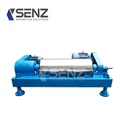
Hey there! As a supplier of Fish Oil Decanter Centrifuges, I've been getting a lot of questions lately about the impact of bowl diameter on the separation capacity of these machines. So, I thought I'd take some time to break it down for you all.
First off, let's talk about what a fish oil decanter centrifuge actually does. Essentially, it's a piece of equipment that separates different components of fish oil, like water, solids, and the oil itself. This is super important in the fish oil industry because it helps to purify the oil and make it suitable for various applications, whether it's for human consumption, animal feed, or other industrial uses.
Now, the bowl diameter of a decanter centrifuge plays a crucial role in its separation capacity. You can think of the bowl as the heart of the centrifuge. It's where all the magic happens. When the centrifuge is spinning, the different components of the fish oil are separated based on their density. The heavier components, like solids and water, are pushed towards the outer wall of the bowl, while the lighter oil stays closer to the center.
So, how does the bowl diameter affect this process? Well, a larger bowl diameter generally means a higher separation capacity. Why is that? When the bowl is bigger, there's more space for the different components to separate. This allows the centrifuge to handle a larger volume of fish oil at once. For example, if you have a small - diameter bowl, it might get overwhelmed with a large amount of fish oil, and the separation won't be as efficient. The heavier components might not have enough time or space to move to the outer wall properly, leading to a less pure oil product.
On the other hand, a centrifuge with a larger bowl diameter can spin at a relatively lower speed while still achieving good separation. This is great because it reduces wear and tear on the machine, and also saves energy. You don't have to push the centrifuge to its limits to get the job done.
But it's not all sunshine and rainbows with a large - diameter bowl. There are some drawbacks too. Larger bowls are usually more expensive to manufacture. They also take up more space, which can be a problem if you have limited room in your production facility. And let's not forget about the maintenance. A bigger bowl means more parts to clean and maintain, which can increase the overall cost of operation.
Now, if you're in the market for a fish oil decanter centrifuge, it's important to find the right balance. You need to consider your production volume, the purity requirements of your fish oil, and your budget. If you have a small - scale operation, a centrifuge with a smaller bowl diameter might be sufficient. It'll be more affordable and easier to manage. But if you're running a large - scale factory, you'll probably need a centrifuge with a larger bowl to keep up with the demand.
At our company, we offer a range of fish oil decanter centrifuges with different bowl diameters to suit various needs. Whether you're just starting out or you're an established player in the industry, we've got you covered.


By the way, if you're interested in other types of centrifuges, we also have some great options. Check out our Centrifuge Machine For Sludge Dewatering, which is perfect for separating water from sludge in a variety of industries. We also have an Olive Oil Extractor Machine that can efficiently extract high - quality olive oil. And if you need to separate oil and water, our Centrifuge For Oil Water Separation is a top - notch choice.
If you're thinking about purchasing a fish oil decanter centrifuge or any of our other products, we'd love to have a chat with you. We can help you figure out the best bowl diameter for your specific needs and provide you with all the information you need to make an informed decision. Don't hesitate to reach out and start a conversation about your procurement requirements.
In conclusion, the bowl diameter of a fish oil decanter centrifuge has a significant impact on its separation capacity. It's a key factor that you need to consider when choosing a centrifuge for your fish oil production. Whether you go for a small - diameter or a large - diameter bowl, make sure it fits your production goals and budget.
References
- Smith, J. (2020). Centrifuge Technology in the Oil Industry. Journal of Industrial Engineering.
- Johnson, A. (2019). The Impact of Bowl Design on Centrifuge Performance. Separation Science Review.