
Hey there! As a supplier of Oil Water Separators, I often get asked about the difference between static and dynamic oil water separators. So, I thought I'd share my knowledge on this topic and give you a clear understanding of these two types of separators.
Let's start with static oil water separators. Static separators are pretty straightforward. They work based on the principle of gravity. You see, oil and water have different densities. Oil is lighter than water, so when a mixture of oil and water is left undisturbed in a static separator, the oil naturally rises to the top, and the water settles at the bottom.
These separators are relatively simple in design. They usually consist of a tank where the oil - water mixture is introduced. There are baffles or plates inside the tank that help to slow down the flow of the mixture, allowing more time for the oil to separate from the water. Static separators are great for applications where the flow rate is relatively low and the oil content in the water is not too high. They are also cost - effective and require less maintenance compared to dynamic separators.
One of the main advantages of static separators is their simplicity. They don't have many moving parts, which means there's less that can go wrong. They are also easy to install and operate. You just need to make sure that the inlet and outlet connections are properly set up, and the separator is placed on a level surface.
However, static separators also have their limitations. They are not very efficient when it comes to separating emulsified oil. Emulsified oil is oil that is mixed with water in such a way that the oil droplets are very small and evenly distributed throughout the water. Static separators struggle to separate these small oil droplets because the gravity force is not strong enough to make them rise to the surface quickly. Also, if the flow rate of the oil - water mixture is too high, the oil may not have enough time to separate properly, and some oil may end up in the water outlet.
Now, let's talk about dynamic oil water separators. Dynamic separators use mechanical force to separate oil from water. They are more complex than static separators and usually involve some kind of rotating or moving component.
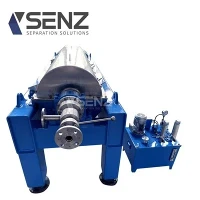
One common type of dynamic separator is the centrifuge. A centrifuge works by spinning the oil - water mixture at a high speed. The centrifugal force generated by the spinning action causes the heavier water to move towards the outer edge of the centrifuge, while the lighter oil moves towards the center. This allows for a more efficient separation of oil and water, even when dealing with emulsified oil.
Another type of dynamic separator is the Volute Screw Press. It uses a screw mechanism to separate the oil and water. The screw rotates, and as it does, it compresses the oil - water mixture, forcing the water out through small holes in the screw housing, while the oil is retained.
Dynamic separators are much more efficient than static separators when it comes to separating emulsified oil and handling high - flow rates. They can achieve a higher level of separation, which means that the water leaving the separator is cleaner and contains less oil.
However, dynamic separators also have some drawbacks. They are more expensive to purchase and operate. They require more maintenance because of the moving parts. There is also a higher risk of mechanical failure, which can lead to downtime and increased costs.
So, how do you decide which type of separator is right for your application? Well, it depends on several factors. If you have a low - flow application with a relatively low oil content and you're on a tight budget, a static separator might be the way to go. It's simple, cost - effective, and easy to maintain.
On the other hand, if you're dealing with emulsified oil or have a high - flow application where a high level of separation is required, a dynamic separator is probably a better choice. It can handle the more challenging separation tasks, but you'll need to be prepared to invest more in terms of both money and maintenance.
As an Oil Water Separator supplier, I've seen a wide range of applications for both static and dynamic separators. For example, in the automotive industry, static separators are often used in small - scale workshops to separate oil from the wastewater generated during vehicle maintenance. In larger industrial settings, such as refineries or chemical plants, dynamic separators are more commonly used because of the high - flow rates and the need for a high level of separation.


If you're in the market for an oil water separator, whether it's a static or a dynamic one, I'd be more than happy to help you find the right solution for your needs. We offer a variety of oil water separators that are designed to meet different requirements. Our team of experts can provide you with detailed information about each type of separator and help you make an informed decision.
We also have other related products that might be of interest to you. For example, our Centrifuge Wastewater Treatment system is a great option for treating wastewater that contains oil and other contaminants. And if you're in the coal tar industry, our Coal Tar Decanter Centrifuge can help you separate coal tar from other substances.
If you're interested in learning more about our products or have any questions about oil water separators, don't hesitate to reach out. We're here to assist you in finding the best solution for your specific application. Whether you need a simple static separator for a small - scale operation or a high - performance dynamic separator for a large industrial facility, we've got you covered.
In conclusion, understanding the difference between static and dynamic oil water separators is crucial when it comes to choosing the right equipment for your business. Each type has its own advantages and disadvantages, and the choice depends on your specific needs and requirements. If you're looking for a reliable and efficient oil water separator, feel free to contact us, and we'll work with you to find the perfect solution.
References:
- Industry standards and guidelines for oil water separation
- Technical literature from separator manufacturers