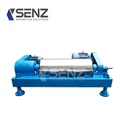
Surface tension is a fundamental physical property that plays a crucial role in various natural and industrial processes. In the context of sewage treatment, the surface tension of sewage can significantly impact the separation efficiency in a sewage decanter centrifuge. As a leading supplier of sewage decanter centrifuges, we have witnessed firsthand the influence of surface tension on the performance of our equipment. In this blog post, we will delve into the relationship between sewage surface tension and separation in a decanter centrifuge, exploring the underlying mechanisms and practical implications.
Understanding Surface Tension in Sewage
Surface tension is defined as the force acting per unit length perpendicular to an imaginary line drawn on the surface of a liquid. It is a result of the cohesive forces between liquid molecules. In sewage, surface tension is influenced by a variety of factors, including the presence of organic and inorganic contaminants, surfactants, and dissolved gases. Organic matter, such as fats, oils, and grease (FOG), can reduce surface tension by adsorbing at the liquid-air interface and disrupting the cohesive forces between water molecules. Surfactants, which are commonly found in sewage due to their widespread use in household and industrial cleaning products, can also lower surface tension by forming a monolayer at the interface.
The surface tension of sewage can have a profound impact on the behavior of suspended particles and droplets during the separation process in a decanter centrifuge. When the surface tension is high, the cohesive forces between water molecules are strong, causing the liquid to form spherical droplets and minimizing the contact area between the liquid and solid phases. This can make it more difficult for the centrifuge to separate the solid particles from the liquid phase, as the droplets tend to resist deformation and remain intact. On the other hand, when the surface tension is low, the cohesive forces are weaker, allowing the liquid to spread out and form a more continuous phase. This can enhance the separation efficiency by facilitating the sedimentation of solid particles and the coalescence of droplets.
The Role of Surface Tension in Decanter Centrifuge Separation
A sewage decanter centrifuge is a type of centrifuge that uses centrifugal force to separate solid particles from a liquid phase. The centrifuge consists of a rotating bowl and a screw conveyor that rotates at a slightly different speed. As the sewage enters the centrifuge, it is subjected to a high centrifugal force, which causes the solid particles to sediment to the wall of the bowl. The screw conveyor then transports the sedimented solids towards the discharge end of the centrifuge, while the clarified liquid is discharged through an outlet at the other end.
The surface tension of sewage can affect the separation process in several ways. First, it can influence the formation and stability of the liquid film on the surface of the solid particles. When the surface tension is high, the liquid film tends to be thicker and more stable, which can prevent the solid particles from coming into contact with each other and forming larger aggregates. This can result in a lower sedimentation rate and a poorer separation efficiency. Conversely, when the surface tension is low, the liquid film is thinner and less stable, allowing the solid particles to collide and aggregate more easily. This can enhance the sedimentation rate and improve the separation efficiency.


Second, surface tension can affect the coalescence of droplets in the liquid phase. In a sewage decanter centrifuge, the liquid phase often contains small droplets of oil, grease, or other contaminants. These droplets can coalesce to form larger droplets, which can then be more easily separated from the liquid phase. When the surface tension is high, the droplets tend to be more stable and less likely to coalesce. This can result in a higher concentration of small droplets in the clarified liquid, reducing the quality of the separation. On the other hand, when the surface tension is low, the droplets are more likely to coalesce, leading to a lower concentration of small droplets in the clarified liquid and a better separation quality.
Practical Implications for Sewage Treatment
The influence of surface tension on the separation efficiency in a sewage decanter centrifuge has several practical implications for sewage treatment. First, it highlights the importance of controlling the surface tension of sewage before it enters the centrifuge. This can be achieved by adding chemicals, such as surfactants or defoamers, to the sewage to adjust its surface tension. Surfactants can be used to lower the surface tension and enhance the separation efficiency, while defoamers can be used to reduce the formation of foam, which can interfere with the separation process.
Second, the surface tension of sewage can also affect the performance of other sewage treatment processes, such as flocculation and sedimentation. Flocculation is a process in which chemicals are added to the sewage to cause the suspended particles to aggregate into larger flocs, which can then be more easily removed by sedimentation. The surface tension of sewage can influence the effectiveness of flocculation by affecting the interaction between the flocculant and the suspended particles. When the surface tension is high, the flocculant may have difficulty adsorbing onto the surface of the particles, reducing the flocculation efficiency. Conversely, when the surface tension is low, the flocculant can more easily adsorb onto the particles, enhancing the flocculation efficiency.
Finally, the surface tension of sewage can also have an impact on the maintenance and operation of sewage decanter centrifuges. When the surface tension is high, the centrifuge may require more frequent cleaning and maintenance to remove the buildup of solid particles and contaminants on the walls of the bowl and the screw conveyor. This can increase the operating costs and downtime of the centrifuge. On the other hand, when the surface tension is low, the centrifuge may operate more smoothly and require less maintenance, reducing the operating costs and improving the reliability of the equipment.
Our Solutions as a Sewage Decanter Centrifuge Supplier
As a leading supplier of sewage decanter centrifuges, we understand the importance of surface tension in the separation process. That's why we offer a range of high-quality centrifuges that are designed to handle sewage with varying surface tensions. Our High Speed Decanter Centrifuge is specifically engineered to provide efficient separation even in challenging sewage treatment applications. With its high rotational speed and advanced design, this centrifuge can effectively separate solid particles from the liquid phase, regardless of the surface tension of the sewage.
In addition to our standard centrifuges, we also offer customized solutions to meet the specific needs of our customers. Our team of experienced engineers can work with you to design and manufacture a centrifuge that is tailored to your sewage treatment requirements. Whether you need a centrifuge for Paper Pulp Wastewater Treatment or Soymilk Decanter Centrifuge, we have the expertise and resources to deliver a solution that meets your expectations.
Conclusion
In conclusion, the surface tension of sewage can have a significant impact on the separation efficiency in a sewage decanter centrifuge. By understanding the underlying mechanisms and practical implications of surface tension, sewage treatment plants can optimize their separation processes and improve the quality of their treated water. As a leading supplier of sewage decanter centrifuges, we are committed to providing our customers with the highest quality equipment and solutions to meet their sewage treatment needs. If you are interested in learning more about our products or discussing your specific requirements, please do not hesitate to contact us. We look forward to working with you to achieve your sewage treatment goals.
References
- Adamson, A. W., & Gast, A. P. (1997). Physical chemistry of surfaces. John Wiley & Sons.
- Bird, R. B., Stewart, W. E., & Lightfoot, E. N. (2002). Transport phenomena. John Wiley & Sons.
- McCabe, W. L., Smith, J. C., & Harriott, P. (2005). Unit operations of chemical engineering. McGraw-Hill.