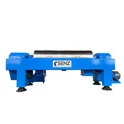
Hey there! As a supplier of soymilk decanter centrifuges, I often get asked a bunch of questions about what these machines can and can't do. One question that comes up quite a bit is, "Can a soymilk decanter centrifuge be used for separating soy protein from soymilk?" Well, let's dive into this topic and see what we can find out.
First off, let's talk a bit about what a soymilk decanter centrifuge is. It's a piece of equipment that uses centrifugal force to separate different components in a liquid mixture. In the case of soymilk, it can be used to separate solids from the liquid, like the pulp from the milk. But when it comes to separating soy protein, things get a bit more complicated.
Soy protein is a valuable component of soymilk. It's used in a wide range of food products, from protein bars to tofu. The process of separating soy protein from soymilk involves several steps, and a decanter centrifuge can play an important role in some of them.
One of the main ways a soymilk decanter centrifuge can help is in the initial separation of the soymilk components. When soybeans are ground and mixed with water to make soymilk, there are different types of particles in the mixture. The decanter centrifuge can spin the soymilk at high speeds, causing the heavier particles (like the pulp) to move to the outer edge of the centrifuge bowl, while the lighter liquid (the soymilk with the protein) stays in the center. This initial separation helps to remove a large portion of the unwanted solids.
However, separating soy protein completely is not as simple as just using a centrifuge. Soy protein exists in different forms and sizes in soymilk, and there are other components like fats and carbohydrates that also need to be considered. After the initial separation with the decanter centrifuge, further purification steps are usually required.
For example, after the centrifuge separates the major solids, the soymilk may still contain some fine particles and impurities. To get a more pure soy protein, additional processes like filtration or chromatography might be needed. But the decanter centrifuge is a great starting point. It can significantly reduce the amount of solids in the soymilk, making the subsequent purification steps more efficient.
Now, let's talk about some of the benefits of using a soymilk decanter centrifuge for this process. One of the biggest advantages is its efficiency. It can handle large volumes of soymilk in a relatively short time. This is important for commercial soymilk production, where time is money.
Another benefit is its reliability. These centrifuges are designed to work continuously for long periods without much maintenance. This means less downtime and more consistent production.
But it's not all sunshine and rainbows. There are some challenges when using a soymilk decanter centrifuge for soy protein separation. One of the main issues is the clogging of the centrifuge. The fine particles in the soymilk can build up over time and block the machine, reducing its efficiency. Regular cleaning and maintenance are essential to keep the centrifuge running smoothly.
Also, the separation efficiency can be affected by factors like the speed of the centrifuge, the temperature of the soymilk, and the composition of the soybeans. Different types of soybeans may have different protein contents and characteristics, which can impact how well the centrifuge works.
Now, if you're in the business of soymilk production or soy protein extraction, you might be interested in some of the other applications of decanter centrifuges. For example, they can be used in Slaughterhouse Wastewater Treatment. In this process, the centrifuge helps to separate the solid waste from the wastewater, making it easier to treat and dispose of.
They're also used in Oil Field Centrifuge applications. In the oil industry, centrifuges are used to separate oil, water, and solids from drilling mud. This helps to recycle the mud and reduce waste.
And for those dealing with wastewater treatment in general, a Decanter Centrifuge Separation Wastewater system can be a great solution. It can separate the solids from the wastewater, making it cleaner and easier to treat.
So, can a soymilk decanter centrifuge be used for separating soy protein from soymilk? The answer is yes, but it's just one part of the process. It can be a very effective tool for the initial separation, but additional steps are usually needed to get a pure soy protein product.


If you're interested in learning more about our soymilk decanter centrifuges or have any questions about how they can be used in your soy protein separation process, don't hesitate to get in touch. We're here to help you find the best solution for your business. Whether you're a small-scale soymilk producer or a large industrial operation, we have the expertise and the equipment to meet your needs.
Let's work together to take your soymilk production and soy protein extraction to the next level. Contact us today to start the conversation!
References:
- "Principles of Food Science and Technology" by John M. Jay
- "Centrifugal Separation in the Food Industry" by Robert H. Perry