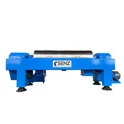

In the realm of industrial separation processes, the question of whether a 3 - Phase Decanter Centrifuge can be used for continuous separation is a topic of great interest. As a supplier of 3 - Phase Decanter Centrifuges, I am well - versed in the capabilities and applications of these remarkable machines.


Understanding the 3 - Phase Decanter Centrifuge
A 3 - Phase Decanter Centrifuge is a highly efficient piece of equipment designed to separate mixtures into three distinct phases: a solid phase and two immiscible liquid phases. This separation is achieved through the principle of centrifugal force. The centrifuge rotates at high speeds, causing the denser components to move towards the outer wall of the centrifuge bowl, while the less dense components remain closer to the center.
The design of a 3 - Phase Decanter Centrifuge typically consists of a rotating bowl, a screw conveyor, and various inlets and outlets. The mixture to be separated is fed into the centrifuge through an inlet. As the centrifuge rotates, the solid particles are sedimented on the inner wall of the bowl and are then conveyed out by the screw conveyor. The two liquid phases, with different densities, are separated and discharged through separate outlets.
Continuous Separation with 3 - Phase Decanter Centrifuges
One of the key advantages of a 3 - Phase Decanter Centrifuge is its ability to perform continuous separation. Continuous separation is crucial in many industrial processes as it allows for a steady and efficient production flow.
In a continuous separation process using a 3 - Phase Decanter Centrifuge, the feed material is continuously introduced into the centrifuge. The centrifuge operates continuously, separating the mixture into its three phases without the need for frequent stops and starts. This continuous operation results in higher productivity and reduced downtime.
For example, in the food industry, a 3 - Phase Decanter Centrifuge can be used for the continuous separation of oil, water, and solids in olive or avocado oil extraction. The Horizontal Separation Equipment Olive Avocado Oil Extraction Machine is specifically designed for this purpose. The centrifuge can handle a continuous flow of olive or avocado pulp, separating the oil, water, and solid residues efficiently.
In the wastewater treatment industry, continuous separation is also essential. A 3 - Phase Decanter Centrifuge can be used to separate sludge, water, and oil in a continuous manner. The Sludge Dewatering Unit is a prime example of a 3 - Phase Decanter Centrifuge application in wastewater treatment. It can continuously remove water from the sludge, reducing its volume and making it easier to handle and dispose of.
Advantages of Continuous Separation with 3 - Phase Decanter Centrifuges
- High Efficiency: Continuous separation allows for a higher throughput of the feed material. Since the centrifuge operates continuously, it can process a large volume of the mixture in a relatively short time. This results in increased productivity and cost - effectiveness.
- Consistent Quality: Continuous separation ensures a consistent quality of the separated phases. The centrifuge operates under stable conditions, which leads to more uniform separation results. This is particularly important in industries where product quality is critical, such as the pharmaceutical and food industries.
- Reduced Labor and Maintenance: Continuous operation reduces the need for frequent manual intervention. Once the centrifuge is set up, it can run for extended periods without the need for constant monitoring. This reduces labor costs and also minimizes the risk of human error. Additionally, continuous operation can lead to reduced wear and tear on the centrifuge components, resulting in lower maintenance requirements.
Applications of 3 - Phase Decanter Centrifuges for Continuous Separation
- Food and Beverage Industry: As mentioned earlier, 3 - Phase Decanter Centrifuges are widely used in the extraction of oils from fruits such as olives and avocados. They can also be used in the separation of milk into cream, skim milk, and solids. The Tricanter Centrifuge is a popular choice in the food industry due to its ability to handle a variety of feed materials and perform continuous separation.
- Chemical Industry: In the chemical industry, 3 - Phase Decanter Centrifuges are used for the separation of different chemical compounds. For example, they can be used to separate solvents, water, and solids in chemical manufacturing processes. Continuous separation in the chemical industry is essential for maintaining a high - quality production process and ensuring the purity of the final products.
- Wastewater Treatment: The wastewater treatment industry relies heavily on 3 - Phase Decanter Centrifuges for the continuous separation of sludge, water, and oil. These centrifuges can effectively remove solids from the wastewater, reducing the environmental impact of the treated water. The continuous operation of the centrifuge allows for a more efficient and cost - effective wastewater treatment process.
Challenges and Considerations
While 3 - Phase Decanter Centrifuges offer many advantages for continuous separation, there are also some challenges and considerations that need to be addressed.
- Feed Characteristics: The characteristics of the feed material, such as its viscosity, density, and particle size, can have a significant impact on the performance of the centrifuge. It is important to ensure that the feed material is suitable for continuous separation in a 3 - Phase Decanter Centrifuge. In some cases, pre - treatment of the feed material may be required to improve its separation properties.
- Operating Conditions: The operating conditions of the centrifuge, such as the rotational speed, feed rate, and temperature, need to be carefully controlled. Improper operating conditions can lead to reduced separation efficiency and even damage to the centrifuge. It is essential to optimize the operating conditions based on the specific requirements of the separation process.
- Maintenance and Cleaning: Continuous operation of the centrifuge requires regular maintenance and cleaning to ensure its proper functioning. The centrifuge components, such as the bowl and the screw conveyor, need to be inspected and cleaned regularly to prevent the buildup of solids and other contaminants.
Conclusion
In conclusion, a 3 - Phase Decanter Centrifuge can indeed be used for continuous separation. Its ability to separate mixtures into three distinct phases in a continuous manner makes it a valuable tool in a wide range of industries. The advantages of continuous separation, such as high efficiency, consistent quality, and reduced labor and maintenance, make 3 - Phase Decanter Centrifuges a popular choice for many industrial applications.
If you are interested in learning more about our 3 - Phase Decanter Centrifuges or would like to discuss your specific separation needs, we encourage you to contact us for a detailed consultation. Our team of experts is ready to assist you in finding the most suitable solution for your continuous separation requirements.
References
- Perry, R. H., & Green, D. W. (Eds.). (2008). Perry's Chemical Engineers' Handbook. McGraw - Hill.
- Coulson, J. M., Richardson, J. F., Backhurst, J. R., & Harker, J. H. (1999). Chemical Engineering Volume 2: Particle Technology and Separation Processes. Butterworth - Heinemann.