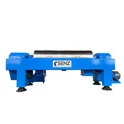

Hey there, folks! As a supplier of fish oil decanter centrifuges, I often get asked about the rotational speed of these machines. It's a crucial factor that can significantly impact the efficiency and effectiveness of fish oil separation. So, let's dive right in and explore what the rotational speed of a fish oil decanter centrifuge is all about.
Understanding the Basics of a Fish Oil Decanter Centrifuge
Before we talk about rotational speed, let's quickly go over what a fish oil decanter centrifuge does. Essentially, it's a piece of equipment designed to separate different components in fish oil mixtures. Fish oil comes from various sources, and it often contains a mix of oil, water, and solid particles. The decanter centrifuge uses centrifugal force to separate these components based on their different densities.
The centrifuge consists of a rotating bowl that spins at high speeds. As the mixture enters the centrifuge, the centrifugal force pushes the heavier components, like solids and water, towards the outer walls of the bowl, while the lighter fish oil stays closer to the center. They are then discharged through different outlets.
What is Rotational Speed?
Rotational speed, in the context of a fish oil decanter centrifuge, refers to how fast the bowl of the centrifuge spins. It's usually measured in revolutions per minute (RPM). The higher the RPM, the greater the centrifugal force generated within the centrifuge.
A higher rotational speed means the centrifuge can separate the components in the fish oil mixture more quickly and efficiently. This is because the greater centrifugal force helps to push the heavier components outwards faster, leading to a more distinct separation between the oil, water, and solids.
Factors Affecting the Rotational Speed
Several factors can influence the ideal rotational speed for a fish oil decanter centrifuge.
1. Type of Fish Oil
Different types of fish oil have different densities and viscosities. For example, the oil from fatty fish like salmon may have a different consistency compared to the oil from leaner fish. The centrifuge may need to spin at a different speed to effectively separate these oils. If the oil is more viscous, a higher rotational speed might be required to ensure proper separation.
2. Purity Requirements
The level of purity you need for the fish oil also plays a role. If you're aiming for a very high - purity fish oil product, you may need to run the centrifuge at a higher speed to remove more of the water and solid impurities. On the other hand, if the purity requirements are not as strict, a lower speed may be sufficient.
3. Feed Rate
The rate at which the fish oil mixture is fed into the centrifuge matters. If the feed rate is high, the centrifuge may need to spin faster to handle the larger volume of material and still achieve proper separation. A slower feed rate might allow for a lower rotational speed.
Typical Rotational Speeds
In general, fish oil decanter centrifuges can operate at a wide range of rotational speeds. Some smaller, less powerful centrifuges may operate at speeds as low as 1500 RPM, while larger, more industrial - grade machines can reach up to 5000 RPM or even higher.
For most medium - scale fish oil processing operations, a rotational speed in the range of 3000 - 4000 RPM is commonly used. This speed range usually provides a good balance between separation efficiency and equipment longevity. At this speed, the centrifuge can effectively remove a significant amount of water and solids from the fish oil, resulting in a relatively pure product.
However, it's important to note that these are just general guidelines. The optimal rotational speed for your specific application should be determined through testing and experimentation. You may need to adjust the speed based on the factors we discussed earlier, such as the type of fish oil, purity requirements, and feed rate.
Importance of the Right Rotational Speed
Getting the rotational speed right is crucial for several reasons.
1. Separation Efficiency
As I mentioned earlier, the right speed ensures that the centrifuge can separate the oil, water, and solids effectively. If the speed is too low, the separation may be incomplete, and you may end up with a fish oil product that still contains a significant amount of impurities. On the other hand, if the speed is too high, it can cause excessive wear and tear on the centrifuge components, leading to increased maintenance costs and a shorter lifespan for the machine.
2. Product Quality
The quality of the fish oil product is directly related to the separation efficiency. A well - separated fish oil with low levels of water and solids will have a better taste, longer shelf - life, and higher nutritional value. By using the correct rotational speed, you can ensure that your fish oil meets the highest quality standards.
3. Cost - Effectiveness
Running the centrifuge at the optimal speed can also save you money in the long run. A properly adjusted speed reduces energy consumption, as the machine doesn't need to work harder than necessary. It also minimizes maintenance costs by reducing wear on the components.
Other Related Applications and Our Offerings
We don't just deal with fish oil decanter centrifuges. Our centrifuges can also be used in other applications. For example, if you're in the avocado oil production business, our Avocado Oil Production Line Decanter can be a great addition to your production line. It uses the same principles of centrifugal separation to produce high - quality avocado oil.
We also offer solutions for Slaughterhouse Wastewater Treatment and Decanter Centrifuge Separation Wastewater. These applications require different settings and rotational speeds depending on the specific wastewater characteristics, but our centrifuges are versatile enough to handle them.
Contact Us for More Information
If you're interested in purchasing a fish oil decanter centrifuge or want to learn more about our other products, don't hesitate to reach out. We have a team of experts who can help you determine the right centrifuge for your needs, including the optimal rotational speed based on your specific requirements. Contact us today to start the discussion about your fish oil processing project.


References
- Chemical Engineering Handbook: Covers fundamental principles of centrifugal separation.
- Fish Oil Processing Industry Reports: Provide real - world data on centrifuge usage in fish oil production.