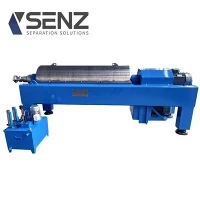

As a supplier of mining decanter centrifuges, I've witnessed firsthand the critical role that feed flow rate plays in the performance and efficiency of these machines. The feed flow rate can significantly impact various aspects of the centrifuge operation, from separation efficiency to machine wear and tear. In this blog post, let's delve into the details of how feed flow rate affects a mining decanter centrifuge.
Separation Efficiency
One of the most crucial impacts of feed flow rate on a mining decanter centrifuge is its effect on separation efficiency. The primary function of a mining decanter centrifuge is to separate solid particles from a liquid suspension. The centrifuge achieves this by subjecting the suspension to high - speed rotation, which generates a centrifugal force that causes the solid particles to settle at the periphery of the centrifuge bowl while the liquid is removed from the center.
When the feed flow rate is too low, the residence time of the suspension in the centrifuge is increased. This longer residence time allows for more thorough separation as the solid particles have more time to settle and be removed from the liquid. As a result, the separated solid phase will have a lower moisture content, and the liquid phase will be clearer with fewer suspended solids. However, running the centrifuge at a very low feed flow rate can reduce the overall throughput, which may not be economically viable for large - scale mining operations.


On the other hand, if the feed flow rate is too high, the suspension passes through the centrifuge too quickly. The solid particles do not have enough time to settle properly, leading to a less effective separation. A significant amount of solid particles may remain suspended in the liquid phase, and the separated solid may have a higher moisture content. This reduces the quality of the separation and can lead to issues downstream in the processing plant. For instance, if the separated solids are to be further processed for metal extraction, a higher moisture content can increase the energy required for subsequent drying steps.
Machine Wear and Tear
The feed flow rate also has a significant impact on the wear and tear of the mining decanter centrifuge components. A high feed flow rate means that more material is flowing through the centrifuge at a faster pace. This can cause increased abrasion on the internal surfaces of the centrifuge bowl, conveyor, and other critical components. The abrasive nature of the solid particles in the mining suspension can wear away the protective coatings and the base material of the components over time.
Moreover, high feed flow rates can lead to increased hydraulic forces within the centrifuge. These forces can put additional stress on the bearings, shafts, and other mechanical parts of the centrifuge. This may result in premature failure of these components, leading to costly repairs and downtime. Regularly running the centrifuge at an excessive feed flow rate can significantly reduce the service life of the machine.
Conversely, a very low feed flow rate may not be entirely beneficial for machine longevity either. At low flow rates, the distribution of the suspension within the centrifuge may not be uniform, which can cause uneven wear on the components. Additionally, the centrifuge may run less smoothly, as the dynamic balance of the rotating parts can be affected by the inconsistent flow of material.
Energy Consumption
Feed flow rate is closely related to the energy consumption of a mining decanter centrifuge. The power required to operate the centrifuge is influenced by several factors, including the feed flow rate. When the feed flow rate is increased, the centrifuge needs to work harder to process the larger volume of material. This generally results in higher energy consumption as the motor has to supply more power to maintain the required rotational speed.
However, there is an optimal feed flow rate range where the centrifuge can achieve the highest separation efficiency with relatively low energy consumption. Operating within this range allows for efficient processing of the mining suspension while minimizing power usage. If the feed flow rate is outside this optimal range, either too low or too high, energy is wasted. At low flow rates, the centrifuge is running but not fully utilizing its capacity, and at high flow rates, the extra energy is used to process an excessive amount of material inefficiently.
Applications in Different Mining Processes
In various mining processes, the appropriate feed flow rate is determined based on the characteristics of the suspension and the desired separation outcome. For example, in coal mining, the feed suspension typically contains coal particles and water. The feed flow rate needs to be carefully adjusted to ensure that the coal particles are effectively separated from the water and other impurities. If the flow rate is too high, valuable coal may be lost in the waste water, and if it is too low, the production capacity of the centrifuge will be limited.
In metal mining, such as copper or gold mining, the feed suspension contains a mixture of ore particles, water, and chemical reagents. The feed flow rate affects the separation of the ore from the gangue (the unwanted rock and minerals). A proper feed flow rate is essential to maximize the recovery of the valuable metal while minimizing the amount of gangue in the concentrate.
Related Applications of Centrifuges
In addition to mining applications, our centrifuges have a wide range of other uses. For example, they are used in Wheat Starch Extraction, where the centrifuge helps to separate the starch from the other components of the wheat. In Yeast Separator applications, the centrifuge is used to separate yeast cells from the fermentation broth. Our centrifuges are also effective in Slaughterhouse Wastewater Treatment, Solid Bowl Decanter Centrifuge operations, and Sand & Gravel Washing Water Treatment.
Conclusion and Call to Action
In conclusion, the feed flow rate has a profound influence on the performance, efficiency, and longevity of a mining decanter centrifuge. It affects separation efficiency, machine wear and tear, and energy consumption. By carefully controlling the feed flow rate and operating the centrifuge within the optimal range, mining companies can achieve better separation results, reduce maintenance costs, and save energy.
If you are involved in a mining operation or any other process that requires solid - liquid separation and are looking for a high - quality decanter centrifuge, we are here to help. Our team of experts can provide you with professional advice on choosing the right centrifuge and setting the appropriate feed flow rate for your specific application. Contact us to discuss your requirements and start a procurement negotiation today.
References
- Smith, J. (2018). Centrifuge Technology in Mining. Mining Engineering Journal, 25(3), 123 - 135.
- Johnson, A. (2019). Impact of Feed Parameters on Decanter Centrifuge Performance. Separation Science Review, 12(4), 201 - 215.