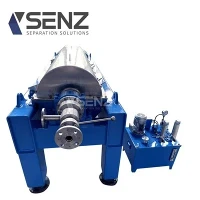

Hey there! As a supplier of soymilk decanter centrifuges, I get asked a lot about the suitable feed rate for these machines. It's a crucial question because getting the feed rate right can make a huge difference in the efficiency and quality of your soymilk production.
Let's start by understanding what a soymilk decanter centrifuge does. It's a piece of equipment that uses centrifugal force to separate the solid and liquid components in soymilk. The feed rate refers to the amount of soymilk that you input into the centrifuge per unit of time.
Factors Affecting the Feed Rate
There are several factors that can influence the ideal feed rate for a soymilk decanter centrifuge.
1. Centrifuge Capacity
The capacity of the centrifuge is a major factor. Different models have different maximum capacities. If you try to feed too much soymilk into a centrifuge that can't handle it, you'll end up with poor separation. For example, a smaller centrifuge might only be able to handle a feed rate of 50 - 100 liters per hour, while a larger industrial - grade centrifuge could handle 500 liters or more per hour.


2. Soymilk Consistency
The consistency of the soymilk also matters. If the soymilk is very thick and has a high solid content, it will flow more slowly through the centrifuge. In this case, you'll need to reduce the feed rate to ensure proper separation. On the other hand, if the soymilk is thin and has a low solid content, you can increase the feed rate a bit.
3. Desired Separation Quality
If you're aiming for a very high - quality separation, with minimal solids in the liquid part of the soymilk, you'll need to slow down the feed rate. This gives the centrifuge more time to separate the components effectively. However, if you're less concerned about the quality of separation and more about the quantity of soymilk processed, you can increase the feed rate.
Finding the Optimal Feed Rate
So, how do you find the optimal feed rate for your soymilk decanter centrifuge?
1. Start with the Manufacturer's Recommendations
Most centrifuge manufacturers provide guidelines on the recommended feed rate for their machines. These are a good starting point. You can find these recommendations in the product manual or by contacting the manufacturer directly.
2. Conduct Tests
Once you have the manufacturer's recommendation, you should conduct some tests. Start with a feed rate slightly lower than the recommended value and gradually increase it while monitoring the separation quality. You can use a simple visual inspection to check if there are still too many solids in the liquid part of the soymilk.
3. Consider the Overall Production Process
You also need to consider how the centrifuge fits into your overall soymilk production process. For example, if you have a limited supply of soymilk, you might want to run the centrifuge at a lower feed rate to ensure maximum separation. But if you're trying to meet a high - volume production target, you'll need to find a balance between the feed rate and the separation quality.
Impact of Incorrect Feed Rate
Using the wrong feed rate can have some negative consequences.
1. Poor Separation
If the feed rate is too high, the centrifuge won't have enough time to separate the solid and liquid components properly. This means that you'll end up with a soymilk that has a high solid content, which can affect its taste and texture.
2. Equipment Damage
Running the centrifuge at a feed rate that's too high can also put extra stress on the machine. This can lead to premature wear and tear, and in some cases, it can even cause the centrifuge to break down.
3. Reduced Efficiency
On the other hand, if the feed rate is too low, you're not making the most of the centrifuge's capacity. This can result in lower production volumes and higher production costs.
Other Types of Centrifuges
In addition to soymilk decanter centrifuges, we also offer other types of centrifuges that might be useful for different applications. For example, if you're interested in protein separation, we have the Protein Centrifuge. It's designed to separate proteins from other components in a liquid.
If you're dealing with kitchen waste, our Kitchen Waste Disposal Centrifuge can help you separate the solid and liquid parts of the waste, making it easier to manage.
And for those in the biodiesel industry, we have the Waste Oil Centrifuge Biodiesel Equipment, which is used to separate impurities from waste oil to produce biodiesel.
Conclusion
In conclusion, finding the suitable feed rate for a soymilk decanter centrifuge is a process that involves considering several factors such as the centrifuge capacity, soymilk consistency, and desired separation quality. By starting with the manufacturer's recommendations and conducting tests, you can find the optimal feed rate for your specific needs.
If you're in the market for a soymilk decanter centrifuge or any of our other centrifuge products, we'd love to talk to you. Whether you're a small - scale soymilk producer or a large industrial operation, we can help you find the right equipment and ensure that you're using it effectively.
References
- Centrifuge operation manuals from various manufacturers
- Industry research on soymilk production and centrifuge technology