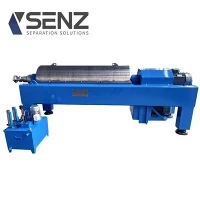

Hey there! As a supplier of 3 Phase Centrifuges, I often get asked about the differences between a 3 Phase Centrifuge and a filtration centrifuge. So, I thought I'd take a moment to break it down for you.


Let's start with the basics. A centrifuge is a machine that uses centrifugal force to separate different components of a mixture. It's like a super - fast spinning device that can separate solids from liquids or different liquids from each other.
3 Phase Centrifuge
A 3 Phase Centrifuge is a pretty nifty piece of equipment. It's designed to separate a mixture into three distinct phases: a heavy solid phase, a light liquid phase, and a heavy liquid phase. This is especially useful in industries where you have a complex mixture that needs to be sorted out.
For example, in the oil and gas industry, a 3 Phase Centrifuge can be used to separate oil, water, and solids from drilling mud. The centrifuge spins at a high speed, and due to the differences in density of the three components, they separate into distinct layers. The heavy solids settle at the bottom, the heavy liquid (usually water) forms a middle layer, and the light liquid (oil) floats on top.
Another great application of 3 Phase Centrifuges is in the food industry. When processing dairy products, it can separate cream, milk, and whey. The cream, being the lightest, rises to the top, the milk forms the middle layer, and the whey, which contains some solids and heavier components, settles at the bottom.
One of the key advantages of a 3 Phase Centrifuge is its efficiency. It can handle large volumes of mixtures in a relatively short time. It also doesn't require a lot of manual intervention once it's set up correctly. The separation process is continuous, which means it can keep running for long periods without interruption.
Filtration Centrifuge
On the other hand, a filtration centrifuge is mainly focused on separating solids from liquids using a filtration medium. The centrifuge spins, and the liquid is forced through a filter, leaving the solids behind on the filter.
Filtration centrifuges are commonly used in industries where you need to obtain a clear liquid from a suspension. For instance, in the pharmaceutical industry, they are used to separate crystals from a liquid solution during the drug - manufacturing process. The spinning action of the centrifuge helps to push the liquid through the filter, and the crystals are left on the filter surface.
In the chemical industry, filtration centrifuges can be used to separate precipitates from a chemical reaction mixture. The solid precipitates are retained on the filter, and the clear liquid passes through.
One of the main limitations of a filtration centrifuge is that the filter can get clogged over time. This requires regular maintenance and replacement of the filter media. Also, the filtration process can be slower compared to a 3 Phase Centrifuge, especially when dealing with large volumes of mixtures.
Key Differences
Separation Mechanism
The most obvious difference between the two is the separation mechanism. A 3 Phase Centrifuge relies on the differences in density of the components in the mixture to separate them into three phases. It doesn't use a physical filter for separation. In contrast, a filtration centrifuge uses a filter to separate solids from liquids.
Applications
3 Phase Centrifuges are ideal for complex mixtures where you need to separate multiple components. They are commonly used in industries such as oil and gas, food processing, and wastewater treatment. Filtration centrifuges, on the other hand, are more suitable for applications where the main goal is to remove solids from a liquid to obtain a clear filtrate, like in the pharmaceutical and chemical industries.
Efficiency and Maintenance
3 Phase Centrifuges are generally more efficient in terms of processing large volumes. They have a continuous separation process and require less frequent maintenance compared to filtration centrifuges. Filtration centrifuges, as mentioned earlier, can get clogged, which means more downtime for maintenance and filter replacement.
Our 3 Phase Centrifuge Offerings
We offer a range of 3 Phase Centrifuges that are designed to meet the diverse needs of different industries. Our centrifuges are built with high - quality materials and advanced technology to ensure reliable and efficient operation.
One of our popular products is the Sludge Dewatering Unit. It's specifically designed for wastewater treatment plants to separate sludge from water. The unit can handle large volumes of sludge and can significantly reduce the volume of the sludge, making it easier to dispose of.
We also have an Industrial Waste Oil Centrifuge that is perfect for recycling waste oil. It can separate oil, water, and solids from the waste oil, allowing the oil to be reused. This not only helps to save costs but also reduces the environmental impact.
Why Choose Our 3 Phase Centrifuges?
- High - Quality Construction: Our centrifuges are made from top - grade materials that can withstand the harsh conditions of industrial use.
- Advanced Technology: We use the latest technology in our centrifuge design to ensure maximum efficiency and performance.
- Customizable: We understand that different industries have different requirements. That's why our centrifuges can be customized to meet your specific needs.
If you're in the market for a 3 Phase Centrifuge, we'd love to have a chat with you. Whether you're looking to improve your production process, reduce waste, or save costs, our 3 Phase Centrifuges could be the solution you've been looking for. Don't hesitate to reach out to us for more information and to discuss your specific requirements.
References
- "Centrifuge Technology Handbook", John Wiley & Sons
- "Industrial Separation Processes", Elsevier