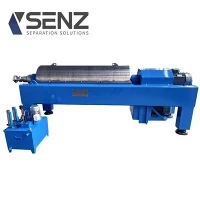

Hey there! As a supplier of 3 - Phase Decanter Centrifuges, I've seen firsthand how these machines can revolutionize various industries. But let's face it, getting the most out of a multi - stage 3 - Phase Decanter Centrifuge isn't always a walk in the park. In this blog, I'm gonna share some tips on how to optimize its operation.
Understanding the Basics
First things first, let's quickly go over what a multi - stage 3 - Phase Decanter Centrifuge does. It's a piece of equipment that separates a mixture into three distinct phases: a heavy liquid phase, a light liquid phase, and a solid phase. This separation happens thanks to the centripetal force generated by the high - speed rotation of the centrifuge.
The key to optimizing its operation lies in understanding the factors that affect the separation process. These include the feed rate, the rotational speed, the differential speed between the bowl and the screw conveyor, and the properties of the feed material itself.
Feed Rate Optimization
The feed rate is crucial. If you feed too much material into the centrifuge too quickly, it won't have enough time to separate properly. On the other hand, if the feed rate is too low, you're not making the most of the centrifuge's capacity.
To find the optimal feed rate, start by looking at the manufacturer's recommendations. These are usually based on the centrifuge's size and design. But keep in mind that the actual optimal rate might vary depending on the specific properties of your feed material.
You can conduct some small - scale tests to find the sweet spot. Start with a relatively low feed rate and gradually increase it while monitoring the quality of the separation. Look for signs like the clarity of the separated liquids and the dryness of the solids. Once you start seeing a decrease in separation efficiency, you've gone too far. Back off a bit and that's your optimal feed rate.
Rotational Speed
The rotational speed of the centrifuge directly affects the centripetal force. A higher rotational speed means a stronger centripetal force, which can lead to better separation. However, there's a limit to how fast you can spin the centrifuge.
Exceeding the recommended rotational speed can cause excessive wear and tear on the machine, and it might even lead to mechanical failures. So, it's important to find the right balance.
Again, refer to the manufacturer's guidelines. They'll give you a range within which the centrifuge can operate safely. Then, based on the characteristics of your feed material, you can adjust the speed to get the best separation. For example, if your material is more difficult to separate, you might want to increase the speed slightly.
Differential Speed
The differential speed is the difference in speed between the bowl and the screw conveyor. This speed difference is responsible for pushing the separated solids out of the centrifuge.
If the differential speed is too high, the solids might be pushed out too quickly, resulting in incomplete separation. Some of the liquid might still be trapped in the solids. On the other hand, if the differential speed is too low, the solids can build up inside the centrifuge, causing blockages and reducing the overall efficiency.
To optimize the differential speed, you need to consider the type and concentration of the solids in the feed material. For a feed with a high solids concentration, you might need a higher differential speed to keep the solids moving out of the centrifuge. You can test different differential speeds to see which one gives you the driest solids and the cleanest separated liquids.
Feed Material Properties
The properties of the feed material, such as its viscosity, density, and particle size, have a huge impact on the separation process.
Viscosity, for example, affects how easily the liquids and solids can move within the centrifuge. A highly viscous material will be more difficult to separate. You might need to adjust the feed rate, rotational speed, or differential speed to compensate for the high viscosity.
Density differences between the phases are also important. The greater the density difference, the easier it is to separate the phases. If the density differences are small, you might need to increase the rotational speed to enhance the separation.
Particle size matters too. Larger particles are generally easier to separate than smaller ones. If your feed material contains a lot of fine particles, you might need to use a flocculant to agglomerate the particles and make them easier to separate.
Maintenance and Monitoring
Regular maintenance is essential for the optimal operation of a multi - stage 3 - Phase Decanter Centrifuge. This includes checking the bearings, belts, and seals for wear and tear, and lubricating the moving parts as recommended by the manufacturer.


Monitoring the performance of the centrifuge is also crucial. Keep an eye on parameters like the feed rate, rotational speed, differential speed, and the quality of the separated phases. You can use sensors and monitoring systems to collect data and detect any changes in the centrifuge's performance early on.
Applications and Related Products
Our 3 - Phase Decanter Centrifuges have a wide range of applications. For example, in the food industry, they're used for separating olive and avocado oil. You can check out our Horizontal Separation Equipment Olive Avocado Oil Extraction Machine for more details on how our centrifuge can be used in this process.
We also offer Tricanter Centrifuge, which is a specialized type of 3 - Phase Decanter Centrifuge designed for more complex separation tasks. And if you're specifically interested in olive oil extraction, our Olive Oil Decanter Centrifuge is a great option.
Conclusion
Optimizing the operation of a multi - stage 3 - Phase Decanter Centrifuge requires a good understanding of the machine and the properties of the feed material. By adjusting the feed rate, rotational speed, differential speed, and taking into account the feed material properties, you can improve the separation efficiency and get the most out of your centrifuge.
Regular maintenance and monitoring are also key to ensuring the long - term performance of the machine. If you have any questions or are interested in purchasing a 3 - Phase Decanter Centrifuge, feel free to reach out for a discussion. I'm always here to help you find the best solution for your needs.
References
- Basic Principles of Centrifugation, various scientific textbooks
- Manufacturer's manuals for 3 - Phase Decanter Centrifuges