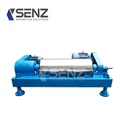

Hey there! As a supplier of 3 Phase Centrifuges, I've been getting a lot of questions lately about the quality standards for these machines. So, I thought I'd take a few minutes to break it down for you.
First off, let's talk about what a 3 Phase Centrifuge actually does. In simple terms, it's a piece of equipment that separates a mixture into three distinct phases - usually a solid phase, a heavy liquid phase, and a light liquid phase. This is super useful in a whole bunch of industries, from food and beverage to chemical and pharmaceutical.
Material Quality
One of the most important quality standards for a 3 Phase Centrifuge is the material it's made from. The parts that come into contact with the mixture being separated need to be made from high - quality, corrosion - resistant materials. Stainless steel is a popular choice because it's durable, easy to clean, and can withstand a wide range of chemicals. For example, in an Industrial Waste Oil Centrifuge, the centrifuge bowls and scrolls are often made of high - grade stainless steel. This ensures that the machine can handle the harsh chemicals and contaminants present in waste oil without getting damaged.


Precision Engineering
Precision is key when it comes to 3 Phase Centrifuges. The internal components, like the centrifuge bowl and the scroll conveyor, need to be machined to extremely tight tolerances. A slight misalignment or an inaccurate dimension can lead to poor separation efficiency. For instance, the gap between the scroll and the bowl in a Tricanter Centrifuge needs to be just right. If it's too wide, the separation won't be as effective, and if it's too narrow, there's a risk of the components rubbing against each other, causing wear and tear.
Separation Efficiency
The whole point of a 3 Phase Centrifuge is to separate the mixture into its three phases as effectively as possible. So, a high - quality centrifuge should have excellent separation efficiency. This is measured by how well it can separate the solid, heavy liquid, and light liquid phases. In an Olive Oil Decanter Centrifuge, for example, the goal is to separate the olive oil from the water and solid particles. A good centrifuge will be able to extract a high percentage of pure olive oil with minimal impurities.
Motor and Drive System
The motor and drive system are the powerhouses of the 3 Phase Centrifuge. They need to be reliable and efficient. A high - quality motor should be able to provide enough torque to spin the centrifuge bowl at the required speed. The drive system should also be able to control the speed accurately. Variable frequency drives (VFDs) are often used in modern 3 Phase Centrifuges because they allow for precise speed control. This is important because different mixtures may require different spinning speeds for optimal separation.
Safety Features
Safety is always a top priority. A quality 3 Phase Centrifuge should be equipped with a range of safety features. For example, it should have an over - speed protection system to prevent the centrifuge from spinning too fast, which could be dangerous. There should also be a vibration monitoring system. Excessive vibration can indicate a problem with the machine, such as an unbalanced load, and the system should be able to shut down the centrifuge to prevent damage or injury.
Ease of Maintenance
Let's face it, no one wants to deal with a machine that's a pain to maintain. A good 3 Phase Centrifuge should be designed for easy maintenance. The components should be easily accessible, and there should be clear instructions on how to perform routine maintenance tasks like cleaning, lubrication, and part replacement. This not only saves time but also reduces the overall cost of ownership.
Noise and Vibration Levels
In a working environment, excessive noise and vibration can be a nuisance. A high - quality 3 Phase Centrifuge should operate quietly and with minimal vibration. This is achieved through proper design and balancing of the internal components. For example, the centrifuge bowl should be balanced during the manufacturing process to reduce vibration. And the machine should be mounted on a vibration - dampening base to further minimize the impact on the surrounding environment.
Testing and Certification
Before a 3 Phase Centrifuge leaves the factory, it should undergo rigorous testing. This includes performance testing to ensure that it meets the specified separation efficiency, as well as safety testing to verify that all the safety features are working properly. Additionally, the centrifuge should have relevant certifications, such as CE certification in Europe. These certifications are a sign that the machine meets the required quality and safety standards.
Customization Options
Every industry and every application is different. That's why a good 3 Phase Centrifuge supplier should offer customization options. For example, if you're in the food industry, you may need a centrifuge that's designed to meet strict hygiene standards. Or if you're dealing with a particularly viscous mixture, you may need a centrifuge with a more powerful motor. A supplier who can customize the centrifuge to your specific needs is definitely a plus.
After - Sales Support
Last but not least, after - sales support is crucial. Even the best machines can have problems from time to time, and you need a supplier who will be there to help you. This includes providing technical support, supplying spare parts, and offering maintenance services. A supplier with a good reputation for after - sales support can give you peace of mind knowing that you're not on your own if something goes wrong.
So, there you have it - the main quality standards for a 3 Phase Centrifuge. If you're in the market for a 3 Phase Centrifuge and want to learn more about how our products meet these standards, don't hesitate to get in touch. We'd be more than happy to have a chat with you and discuss your specific requirements. Whether you're looking for an Industrial Waste Oil Centrifuge, an Olive Oil Decanter Centrifuge, or a Tricanter Centrifuge, we've got you covered.
References
- "Centrifuge Technology Handbook" - A comprehensive guide on centrifuge design and operation.
- Industry standards and guidelines for centrifuge manufacturing.