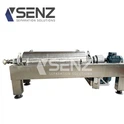

As a supplier of mining decanter centrifuges, I've seen these machines in action day in and day out. They're real workhorses in the mining industry, helping to separate solids from liquids efficiently. But like any piece of equipment, they've got their limitations when it comes to continuous operation. Let's dig into what those are.
Wear and Tear
One of the biggest issues with continuous operation of a mining decanter centrifuge is wear and tear. These machines are spinning at high speeds to create the centrifugal force needed for separation. All that motion causes parts to rub against each other, and over time, this leads to significant wear.
The bearings, for example, are under constant stress. They support the rotating parts of the centrifuge, but continuous operation can cause them to heat up and wear down. If the bearings go bad, it can lead to a whole host of problems, like misalignment of the rotating components, which can then cause vibrations and further damage to the machine.
The conveyor blades are another part that takes a beating. They're responsible for moving the separated solids out of the centrifuge. With continuous operation, the blades are constantly in contact with the abrasive solids, which can cause them to erode. Once the blades start to wear, the efficiency of the solids removal drops, and you might end up with more solids in the liquid phase than you'd like.
Heat Generation
Continuous operation also means continuous heat generation. The high - speed rotation of the centrifuge creates friction, which in turn produces heat. If the heat isn't managed properly, it can cause a lot of issues.


First off, excessive heat can damage the seals in the centrifuge. The seals are crucial for preventing leaks and maintaining the integrity of the separation process. When they get too hot, they can warp or break down, leading to leaks of the liquid or solid materials. This not only messes up the separation but can also be a safety hazard.
Heat can also affect the performance of the motor. The motor has to work hard to keep the centrifuge spinning, and if it gets too hot, it can overheat and fail. A failed motor means the centrifuge stops working, and you're looking at costly downtime for repairs.
Maintenance and Downtime
With continuous operation, the need for regular maintenance goes up significantly. You can't just let the centrifuge run non - stop without checking on it. But maintenance means downtime, and in a mining operation, downtime can be really costly.
When it's time for maintenance, you have to shut down the centrifuge, which means production stops. And the more often you need maintenance, the more production time you lose. Plus, maintenance isn't just about checking the machine; it can also involve replacing worn - out parts. These parts can be expensive, and the cost adds up over time.
Feed Variability
The feed to the mining decanter centrifuge can vary a lot, especially in continuous operation. The composition of the slurry being fed into the centrifuge can change in terms of the particle size distribution, the concentration of solids, and the viscosity of the liquid.
If the particle size distribution changes, the centrifuge might not be able to separate the solids and liquids as effectively. Larger particles might not be properly removed, or smaller particles might end up in the wrong phase. Changes in the solids concentration can also affect the performance. If the concentration is too high, the centrifuge might get overloaded, and the separation efficiency will drop. And variations in viscosity can make it harder for the centrifuge to create the right conditions for separation.
Energy Consumption
Continuous operation of a mining decanter centrifuge requires a lot of energy. The motor has to run constantly to keep the centrifuge spinning at high speeds, and this energy consumption can be a major limitation.
High energy consumption means higher operating costs. In today's world, where energy prices are always fluctuating, this can really eat into the profit margins of a mining operation. And from an environmental perspective, it's not great either. The more energy the centrifuge uses, the larger its carbon footprint.
Limited Capacity
Every mining decanter centrifuge has a maximum capacity. When operating continuously, there's a risk of exceeding this capacity, especially if the feed rate is not properly controlled.
If the centrifuge is overloaded, it won't be able to separate the solids and liquids effectively. The solids might not be removed completely, and the liquid might still contain a high level of solids. This can lead to problems downstream in the processing plant, like clogging of pipes or damage to other equipment.
Impact on Product Quality
Continuous operation can also have an impact on the quality of the separated products. As the centrifuge wears and its performance degrades over time, the quality of the separated solids and liquids can suffer.
For example, if the centrifuge is not removing all the solids from the liquid, the liquid might not meet the required purity standards. This can be a big problem if the liquid is going to be reused in the mining process or discharged into the environment. Similarly, the quality of the separated solids can be affected. If the conveyor blades are worn, the solids might not be properly dewatered, which can make them harder to handle and transport.
Solutions and Alternatives
Despite these limitations, there are ways to mitigate them. Regular maintenance schedules can help reduce the effects of wear and tear. Using high - quality parts and lubricants can also extend the lifespan of the centrifuge.
To manage heat, proper cooling systems can be installed. These can help keep the temperature of the centrifuge within a safe range, preventing damage to the seals and the motor.
When it comes to feed variability, advanced control systems can be used to monitor and adjust the feed rate and other parameters in real - time. This can help ensure that the centrifuge is operating at its optimal performance level.
If you're looking for other types of centrifuges for different applications, we also offer Waste Oil Processing Centrifuge, Waste Dewatering, and Separation Decanter Centrifuge.
If you're in the market for a mining decanter centrifuge or want to learn more about how to overcome these limitations, don't hesitate to reach out. We're here to help you make the best decision for your mining operation and ensure that your centrifuge runs as efficiently as possible.
References
- Smith, J. (2020). "Centrifuge Technology in Mining". Mining Journal.
- Johnson, A. (2021). "The Impact of Continuous Operation on Industrial Centrifuges". Industrial Equipment Review.