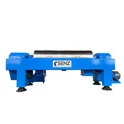

Hey there! As a supplier of Laboratory Centrifuges, I've seen all sorts of these nifty machines up close. In this blog, I'm gonna break down the different types of laboratory centrifuges out there.
1. Benchtop Centrifuges
Benchtop centrifuges are super popular in labs. They're small and can fit right on your lab bench, hence the name. These are great for small - scale experiments and routine tasks. You can use them for separating small volumes of samples, like blood samples for medical testing or cell cultures in biological research.
They usually come with different rotor options. Some have fixed - angle rotors, which are great for pelleting cells or precipitating substances. The fixed - angle design allows for faster sedimentation. Then there are swinging - bucket rotors. These are better for density gradient centrifugation. When you're separating substances based on their density, the swinging - bucket rotor gives you a more accurate separation.
If you're looking for a reliable benchtop centrifuge, check out our Laboratory Centrifuge. It's got all the features you need for your day - to - day lab work.
2. Floor - Standing Centrifuges
Floor - standing centrifuges are the heavy - hitters of the centrifuge world. They're much larger and more powerful than benchtop models. These are used when you need to process large volumes of samples. For example, in a biotech company that's producing large amounts of proteins, a floor - standing centrifuge can handle the high - volume separation of cell debris and proteins.
They often have high - speed capabilities, which means they can spin samples at really fast speeds to achieve efficient separation. Some floor - standing centrifuges can reach speeds of over 20,000 RPM (revolutions per minute). This high - speed spinning is crucial for separating substances with very similar densities.
3. Ultracentrifuges
Ultracentrifuges are the top - of - the - line centrifuges. They can spin at incredibly high speeds, often exceeding 100,000 RPM. These are used for very specialized applications, like separating sub - cellular components, such as ribosomes or mitochondria.
There are two main types of ultracentrifuges: preparative and analytical. Preparative ultracentrifuges are used for isolating and purifying biological molecules. You can use them to prepare samples for further analysis. Analytical ultracentrifuges, on the other hand, are used for studying the physical properties of molecules in solution. They can measure things like molecular weight and sedimentation coefficients.
4. Refrigerated Centrifuges
Refrigerated centrifuges are designed to keep samples at a low temperature during the centrifugation process. This is important for samples that are sensitive to heat, like certain enzymes or biological samples. The refrigeration system helps maintain the integrity of the samples.
These centrifuges are available in both benchtop and floor - standing models. They usually have a temperature control system that allows you to set and maintain a specific temperature. This ensures that your samples are processed under optimal conditions.


5. Microcentrifuges
Microcentrifuges are small, handheld or benchtop devices used for processing very small volumes of samples, typically in the range of microliters. They're commonly used in molecular biology labs for tasks like DNA extraction or PCR (polymerase chain reaction) sample preparation.
They're really convenient because they're easy to use and take up very little space. You can quickly spin down small samples and get the results you need in a short amount of time.
Centrifuges with Special Functions
Apart from the standard types of centrifuges, there are also some with special functions. For example, the Gluten Wheat Flour Separator is a centrifuge designed specifically for separating gluten from wheat flour. It uses the principles of centrifugation to separate the different components of the flour based on their density.
Another interesting one is the Olive Oil Extractor Machine. This centrifuge is used in the food industry to extract olive oil from olives. It separates the oil from the pulp and water, giving you pure olive oil.
Why Choose Our Laboratory Centrifuges?
We've been in the business of supplying laboratory centrifuges for a long time. Our centrifuges are built with high - quality materials and state - of - the - art technology. They're reliable, easy to operate, and come with excellent after - sales support.
Whether you're a small research lab or a large industrial facility, we've got the right centrifuge for you. Our team of experts can help you choose the best centrifuge based on your specific needs and requirements.
If you're interested in purchasing a laboratory centrifuge, don't hesitate to get in touch with us. We're more than happy to discuss your needs and provide you with a quote. We'll work with you to make sure you get the perfect centrifuge for your lab.
References
- "Centrifugation in Biology and Medicine" by David Freifelder
- "Principles of Centrifugation" in the Journal of Laboratory Techniques