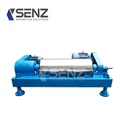

Hey there! As a supplier of Coal Tar Decanter Centrifuges, I've seen firsthand the challenges that come with maintaining the stability of the discharge in these machines. In this blog, I'll share some tips and insights on how you can improve the stability of the discharge of a coal tar decanter centrifuge.
Understanding the Basics
First things first, let's talk about what a coal tar decanter centrifuge does. Essentially, it's a piece of equipment that separates coal tar into different components based on their density. This is done by spinning the coal tar at high speeds, which causes the heavier components to settle at the bottom and the lighter ones to rise to the top. The separated components are then discharged from the centrifuge.
The stability of the discharge is crucial for the efficient operation of the centrifuge. If the discharge is unstable, it can lead to a number of problems, such as uneven separation, increased wear and tear on the equipment, and even downtime. So, how can you improve the stability of the discharge? Let's take a look.
1. Proper Feed Preparation
One of the most important factors in ensuring stable discharge is proper feed preparation. The coal tar that is fed into the centrifuge should be as homogeneous as possible. This means that it should have a consistent density, viscosity, and temperature. If the feed is not homogeneous, it can cause uneven separation and unstable discharge.
To achieve a homogeneous feed, you can use a pre - treatment process. This might involve mixing the coal tar thoroughly, heating it to a consistent temperature, and removing any large particles or contaminants. By doing so, you'll ensure that the centrifuge receives a consistent feed, which will help to improve the stability of the discharge.
2. Optimize Centrifuge Settings
The settings of the centrifuge itself play a big role in the stability of the discharge. These settings include the rotational speed, the differential speed between the bowl and the screw conveyor, and the feed rate.
- Rotational Speed: The rotational speed of the centrifuge affects the centrifugal force acting on the coal tar. A higher rotational speed generally leads to better separation, but it can also cause more wear and tear on the equipment. You need to find the optimal rotational speed for your specific application. This might require some trial and error, but once you find the right speed, it can significantly improve the stability of the discharge.
- Differential Speed: The differential speed between the bowl and the screw conveyor determines how quickly the separated solids are removed from the centrifuge. If the differential speed is too high, it can cause the solids to be discharged too quickly, leading to an unstable discharge. On the other hand, if it's too low, the solids can build up in the centrifuge, causing blockages and other problems. You need to adjust the differential speed based on the characteristics of the coal tar and the desired separation efficiency.
- Feed Rate: The feed rate is another important parameter. If the feed rate is too high, the centrifuge might not be able to handle the volume of coal tar, leading to unstable discharge. Conversely, if the feed rate is too low, it can be inefficient. You need to find the right balance between the feed rate and the centrifuge's capacity.
3. Regular Maintenance
Regular maintenance is essential for the proper functioning of the centrifuge and the stability of the discharge. This includes cleaning the centrifuge regularly to remove any built - up solids or contaminants. Over time, solids can accumulate in the centrifuge, which can affect its performance and lead to unstable discharge.


You should also inspect the centrifuge for any signs of wear and tear, such as damaged seals, bearings, or screw conveyors. Replace any worn - out parts promptly to ensure that the centrifuge operates smoothly. Additionally, lubricate the moving parts regularly to reduce friction and prevent premature failure.
4. Monitoring and Control
Continuous monitoring of the centrifuge's performance is crucial for maintaining stable discharge. You can use sensors to monitor parameters such as the temperature, pressure, and vibration of the centrifuge. By analyzing this data, you can detect any potential problems early and take corrective action before they lead to unstable discharge or equipment failure.
For example, if you notice an increase in vibration, it could indicate a problem with the balance of the centrifuge or the presence of a blockage. By addressing this issue immediately, you can prevent further damage and ensure stable discharge.
5. Consider Upgrading the Equipment
If you're still having problems with the stability of the discharge after trying the above methods, it might be worth considering upgrading your centrifuge. Newer models often come with advanced features and technologies that can improve the separation efficiency and the stability of the discharge.
For instance, some modern centrifuges are equipped with automatic control systems that can adjust the settings in real - time based on the characteristics of the feed. This can help to optimize the performance of the centrifuge and ensure stable discharge.
Related Applications and Products
As a supplier, we also offer a range of other centrifuge products that might be of interest to you. For example, our Olive Oil Separator is designed to separate olive oil from water and solids efficiently. It uses similar principles as the coal tar decanter centrifuge, but is optimized for the unique properties of olive oil.
Our Clarifying Decanter Centrifuge is another great option. It's used for clarifying liquids by removing fine solids, and can be used in a variety of industries.
And if you're in the meat processing industry, our Slaughterhouse Wastewater Treatment centrifuge can help you treat wastewater effectively, separating solids from the liquid and reducing environmental impact.
Conclusion
Improving the stability of the discharge of a coal tar decanter centrifuge is a multi - faceted process that involves proper feed preparation, optimizing centrifuge settings, regular maintenance, monitoring and control, and potentially upgrading the equipment. By following these tips, you can ensure that your centrifuge operates efficiently and provides a stable discharge.
If you're interested in learning more about our coal tar decanter centrifuges or any of our other products, feel free to reach out to us for a purchase negotiation. We're here to help you find the best solution for your specific needs.
References
- "Centrifuge Technology Handbook"
- Industry reports on coal tar processing and centrifuge applications