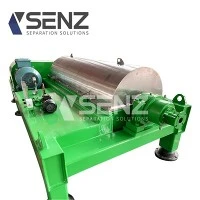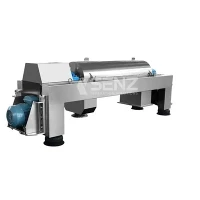

The textile industry is a vast and complex sector that involves numerous processes, from fiber production to fabric finishing. One of the key challenges in this industry is the management of waste and by - products, which often contain a mixture of solid and liquid components. This is where a 2 - Phase Decanter Centrifuge can play a crucial role. As a supplier of 2 - Phase Decanter Centrifuges, I am well - versed in the capabilities of these machines and their potential applications in the textile industry.
Understanding the 2 - Phase Decanter Centrifuge
A 2 - Phase Decanter Centrifuge is a powerful piece of equipment designed to separate two immiscible phases, typically a solid phase and a liquid phase, through centrifugal force. The centrifuge consists of a rotating bowl and a screw conveyor. When the mixture is fed into the centrifuge, the high - speed rotation of the bowl creates a centrifugal field. The denser solid particles are forced to the outer wall of the bowl, while the lighter liquid phase forms an inner layer. The screw conveyor then moves the separated solid phase towards the discharge port, while the liquid phase is discharged through an outlet at the other end.
Applications in the Textile Industry
Wastewater Treatment
The textile industry generates a large amount of wastewater during various processes such as dyeing, printing, and washing. This wastewater often contains suspended solids, dyes, and other contaminants. A 2 - Phase Decanter Centrifuge can be used to separate the solid particles from the liquid in the wastewater. By removing the solids, the quality of the wastewater is improved, making it easier to treat further or even reuse in some cases. For example, in a dyeing process, the centrifuge can separate the dye particles from the water, reducing the environmental impact of the dyeing operation and potentially saving on water and dye costs.
Sludge Dewatering
Textile manufacturing also produces sludge, which is a semi - solid waste material. Sludge dewatering is an important step in waste management as it reduces the volume of the sludge, making it easier and more cost - effective to dispose of. A 2 - Phase Decanter Centrifuge can effectively dewater the sludge by separating the liquid from the solid components. This process not only reduces the volume of the sludge but also increases its dryness, which is beneficial for further treatment or disposal. You can learn more about Centrifuge Sludge Dewatering on our website.
Fiber Recovery
In some textile processes, there is a loss of fibers. These fibers can be recovered using a 2 - Phase Decanter Centrifuge. The centrifuge can separate the fibers from the liquid or other waste materials, allowing them to be reused in the production process. This not only reduces waste but also saves on raw material costs. For instance, in a spinning mill, the centrifuge can recover short fibers that would otherwise be discarded, and these fibers can be blended with new fibers to produce yarn.
Advantages of Using a 2 - Phase Decanter Centrifuge in the Textile Industry
High Efficiency
2 - Phase Decanter Centrifuges are known for their high - speed operation, which allows for rapid separation of the solid and liquid phases. This means that large volumes of textile waste can be processed in a relatively short time, increasing the overall efficiency of the waste management process.
Low Maintenance
These centrifuges are designed to be robust and reliable, with minimal moving parts. This results in lower maintenance requirements and reduced downtime. As a supplier, we ensure that our centrifuges are made from high - quality materials and are built to last, providing long - term value to our customers in the textile industry.
Versatility
The 2 - Phase Decanter Centrifuge can be used in a variety of textile processes, from wastewater treatment to fiber recovery. Its versatility makes it a valuable asset for textile manufacturers who need to manage different types of waste and by - products.


Comparison with Other Separation Methods
There are other separation methods available in the textile industry, such as sedimentation and filtration. However, a 2 - Phase Decanter Centrifuge offers several advantages over these methods.
Sedimentation
Sedimentation is a slow process that relies on gravity to separate the solid and liquid phases. It requires large settling tanks and a long time for the solids to settle. In contrast, a 2 - Phase Decanter Centrifuge uses centrifugal force, which is much stronger than gravity, to achieve a faster and more efficient separation. This means that the centrifuge can handle larger volumes of waste in a shorter time and with less space requirements.
Filtration
Filtration can be effective in separating solids from liquids, but it often requires frequent replacement of filters, which can be costly and time - consuming. Additionally, filtration may not be suitable for separating very fine particles or for handling high - volume waste streams. A 2 - Phase Decanter Centrifuge, on the other hand, does not rely on filters and can handle a wide range of particle sizes and waste volumes.
Case Studies
Let's look at some real - world examples of how 2 - Phase Decanter Centrifuges have been used in the textile industry.
Case 1: A Dyeing Factory
A dyeing factory was facing challenges in treating its wastewater, which was highly contaminated with dyes and suspended solids. The factory installed a 2 - Phase Decanter Centrifuge to separate the solids from the liquid in the wastewater. After the installation, the quality of the wastewater improved significantly, and the factory was able to reuse a large portion of the treated water in its dyeing process. This not only reduced the environmental impact but also saved on water and dye costs.
Case 2: A Textile Mill
A textile mill was generating a large amount of sludge from its washing and finishing processes. The mill used a 2 - Phase Decanter Centrifuge for sludge dewatering. The centrifuge effectively reduced the volume of the sludge, making it easier to transport and dispose of. The dry sludge was then used as a fuel in the mill's boiler, further reducing the mill's energy costs.
Technical Considerations
When selecting a 2 - Phase Decanter Centrifuge for the textile industry, several technical factors need to be considered.
Capacity
The capacity of the centrifuge should be based on the volume of waste that needs to be processed. A larger capacity centrifuge is required for textile factories with high - volume production.
Rotational Speed
The rotational speed of the centrifuge affects the separation efficiency. Higher rotational speeds generally result in better separation, but they also require more power. The optimal rotational speed should be determined based on the characteristics of the waste material.
Material of Construction
The material of construction of the centrifuge should be resistant to corrosion and wear, as the textile waste may contain chemicals and abrasive particles. Stainless steel is a commonly used material for the construction of 2 - Phase Decanter Centrifuges in the textile industry.
Additional Applications
Apart from the main applications in wastewater treatment, sludge dewatering, and fiber recovery, a 2 - Phase Decanter Centrifuge can also be used in other areas of the textile industry. For example, in the production of natural fibers such as cotton and wool, the centrifuge can be used to separate impurities from the fibers. It can also be used in the production of synthetic fibers to separate the polymer from the solvent. You can explore more about our Thickening Centrifuge which may have additional applications in the textile industry.
In the production of sugarcane - based textiles, a 2 - Phase Decanter Centrifuge can be used in the extraction of sugarcane juice. The centrifuge can separate the juice from the solid residue, ensuring a high - quality juice for further processing. To learn more about this application, visit our Sugarcane Juicer page.
Conclusion
In conclusion, a 2 - Phase Decanter Centrifuge can be effectively used in the textile industry for a variety of applications, including wastewater treatment, sludge dewatering, and fiber recovery. Its high efficiency, low maintenance, and versatility make it a valuable asset for textile manufacturers. If you are in the textile industry and are looking for a reliable solution for waste management and separation, we invite you to contact us for a detailed discussion. Our team of experts can help you select the right 2 - Phase Decanter Centrifuge for your specific needs and provide you with comprehensive support throughout the installation and operation process.
References
- Smith, J. (2018). "Advances in Centrifugal Separation Technology in the Textile Industry". Journal of Textile Engineering, 25(3), 123 - 135.
- Brown, A. (2019). "Waste Management in the Textile Sector: The Role of Decanter Centrifuges". International Journal of Textile Science, 12(2), 45 - 56.
- Johnson, R. (2020). "Case Studies of Centrifuge Applications in the Textile Industry". Textile Research Journal, 30(4), 201 - 212.