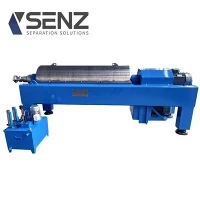

What kind of additives can be used in a 3 - Phase Decanter Centrifuge?
As a reputable supplier of 3 - Phase Decanter Centrifuges, I've had the privilege of working with a diverse range of industries, each with its unique requirements and challenges. One of the most common questions we receive is about the types of additives that can be used in our 3 - Phase Decanter Centrifuges. In this blog post, I'll share some insights into the various additives that can enhance the performance of these centrifuges.
Understanding the Role of Additives in 3 - Phase Decanter Centrifuges
A 3 - Phase Decanter Centrifuge is designed to separate three different phases: a solid phase, a heavy liquid phase, and a light liquid phase. Additives can play a crucial role in facilitating this separation process by improving the settling rate, enhancing the clarity of the separated phases, and reducing the overall energy consumption.
Types of Additives
Flocculants
Flocculants are polymers that are used to aggregate fine particles into larger flocs. This makes it easier for the centrifuge to separate the solid phase from the liquid phases. Flocculants can be either anionic, cationic, or non - ionic, depending on the nature of the particles being separated.
Anionic flocculants are commonly used when the particles have a positive charge. They work by neutralizing the positive charge on the particles and causing them to aggregate. Cationic flocculants, on the other hand, are used for negatively charged particles. Non - ionic flocculants are used when the charge of the particles is not well - defined or when a more gentle flocculation is required.
For example, in the Industrial Waste Oil Centrifuge, flocculants can be used to separate the solid contaminants from the waste oil. By adding the appropriate flocculant, the solid particles will form larger flocs, which can be more easily separated by the centrifuge.


Coagulants
Coagulants are chemicals that are used to neutralize the charge on particles and cause them to come together. They are often used in conjunction with flocculants to enhance the flocculation process. Common coagulants include aluminum sulfate (alum) and ferric chloride.
In the treatment of wastewater, coagulants can be added to the influent to remove suspended solids and colloidal particles. The coagulant neutralizes the charge on the particles, causing them to aggregate. Then, a flocculant can be added to further enhance the flocculation and facilitate the separation in the 3 - Phase Decanter Centrifuge.
pH Adjusters
The pH of the feed material can have a significant impact on the performance of the 3 - Phase Decanter Centrifuge. pH adjusters, such as acids or bases, can be used to optimize the pH of the feed for better separation.
For example, in the Olive Oil Decanter Centrifuge, the pH of the olive paste can affect the extraction of the oil. By adjusting the pH to the optimal range, the separation of the oil, water, and solid phases can be improved.
Antifoaming Agents
Foaming can be a problem in some applications, especially when the feed material contains surfactants or other substances that promote foaming. Antifoaming agents are used to reduce or eliminate foam formation in the centrifuge.
These agents work by breaking the surface tension of the foam bubbles, causing them to collapse. In the operation of a 3 - Phase Decanter Centrifuge, excessive foaming can lead to reduced separation efficiency and increased maintenance requirements. By using an antifoaming agent, these issues can be mitigated.
Factors to Consider When Choosing Additives
When selecting additives for a 3 - Phase Decanter Centrifuge, several factors need to be considered:
- Nature of the Feed Material: The composition, particle size, and charge of the feed material will determine the type of additive that is most suitable. For example, if the feed contains a high proportion of fine particles, a flocculant may be required to improve the settling rate.
- Separation Requirements: The desired quality of the separated phases will also influence the choice of additives. If a high - purity product is required, more advanced additives may be needed.
- Compatibility with the Centrifuge: The additives must be compatible with the materials of construction of the centrifuge. Some additives may cause corrosion or other damage to the centrifuge components if they are not compatible.
- Cost - Effectiveness: The cost of the additives should be balanced against the benefits they provide. In some cases, a more expensive additive may be justified if it significantly improves the separation efficiency and reduces operating costs in the long run.
Applications of 3 - Phase Decanter Centrifuges and Additives
3 - Phase Decanter Centrifuges are used in a wide range of industries, including food and beverage, chemical, pharmaceutical, and environmental. Here are some specific applications and the corresponding additives:
- Food and Beverage Industry: In the Horizontal Separation Equipment Olive Avocado Oil Extraction Machine, flocculants and pH adjusters can be used to improve the extraction of oil from olives and avocados. The additives help to separate the oil from the water and solid pulp more efficiently.
- Chemical Industry: In chemical processes, coagulants and flocculants can be used to separate solids from liquids in the production of various chemicals. This helps to improve the quality of the final product and reduce waste.
- Pharmaceutical Industry: In the pharmaceutical industry, 3 - Phase Decanter Centrifuges are used for the separation of active ingredients from fermentation broths. Additives such as flocculants can be used to enhance the separation and improve the purity of the final product.
- Environmental Industry: In wastewater treatment, coagulants, flocculants, and pH adjusters are commonly used to remove suspended solids, heavy metals, and other contaminants from the wastewater. The 3 - Phase Decanter Centrifuge plays a crucial role in the final separation of the treated water from the sludge.
Conclusion
In conclusion, the use of additives in a 3 - Phase Decanter Centrifuge can significantly improve the separation efficiency and the quality of the separated phases. By carefully selecting the appropriate additives based on the nature of the feed material, separation requirements, and compatibility with the centrifuge, users can achieve optimal performance.
If you are interested in learning more about our 3 - Phase Decanter Centrifuges and the additives that can be used with them, or if you are considering a purchase for your specific application, we encourage you to contact us for a detailed discussion. Our team of experts is ready to assist you in finding the best solution for your needs.
References
- Perry, R. H., & Green, D. W. (2008). Perry's Chemical Engineers' Handbook. McGraw - Hill.
- Svarovsky, L. (1990). Solid - Liquid Separation. Butterworth - Heinemann.