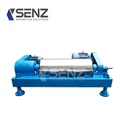

The pharmaceutical industry is a highly regulated and quality - conscious sector where precision, purity, and efficiency are of utmost importance. One of the key processes in many pharmaceutical manufacturing operations is the separation of solids and liquids, which is where a sludge decanter centrifuge can potentially play a significant role. As a sludge decanter centrifuge supplier, I am often asked about the feasibility and benefits of using our equipment in the pharmaceutical industry. In this blog, I will explore whether a sludge decanter centrifuge can indeed be used in the pharmaceutical industry, examining its advantages, challenges, and the specific requirements that need to be met.
How a Sludge Decanter Centrifuge Works
Before delving into its applicability in the pharmaceutical industry, it's essential to understand how a sludge decanter centrifuge operates. A sludge decanter centrifuge is a type of continuous - flow centrifuge that uses centrifugal force to separate solids from liquids in a slurry. The machine consists of a rotating bowl and a screw conveyor. The slurry is fed into the centrifuge, and as the bowl rotates at high speeds, the denser solid particles are forced to the outer wall of the bowl, while the lighter liquid phase forms an inner layer. The screw conveyor then moves the separated solids towards the discharge end of the centrifuge, while the liquid is discharged through separate ports.
Advantages of Using a Sludge Decanter Centrifuge in the Pharmaceutical Industry
High - Efficiency Separation
One of the primary advantages of a sludge decanter centrifuge is its ability to achieve high - efficiency separation. In the pharmaceutical industry, where the purity of products is crucial, the centrifuge can effectively separate solids from liquids, removing impurities and contaminants. For example, in the production of antibiotics, the centrifuge can be used to separate the antibiotic crystals from the fermentation broth, ensuring a high - quality final product.
Continuous Operation
Sludge decanter centrifuges are designed for continuous operation, which is highly beneficial in large - scale pharmaceutical manufacturing. Unlike batch - type separation methods, continuous operation allows for a steady production flow, reducing downtime and increasing overall productivity. This is particularly important in the pharmaceutical industry, where meeting production targets and deadlines is essential.
Versatility
These centrifuges can handle a wide range of feed materials with different viscosities and solid - liquid ratios. In the pharmaceutical industry, this versatility is valuable as it can be used in various processes, such as the separation of cell cultures, the purification of proteins, and the recovery of active pharmaceutical ingredients (APIs).
Space - Saving
Compared to some other separation equipment, sludge decanter centrifuges are relatively compact. In a pharmaceutical manufacturing facility where space is often at a premium, the ability to use a smaller piece of equipment without sacrificing performance is a significant advantage.
Challenges and Considerations
Hygiene and Sterility
The pharmaceutical industry has strict hygiene and sterility requirements. Any equipment used in the production process must be designed and constructed to prevent contamination. Sludge decanter centrifuges need to be made from materials that are resistant to corrosion and easy to clean, such as stainless steel. Additionally, the centrifuge should be designed with smooth surfaces and minimal crevices to prevent the accumulation of bacteria and other contaminants. Regular cleaning and sterilization procedures must be implemented to ensure compliance with pharmaceutical standards.
Particle Size and Shear Sensitivity
Some pharmaceutical products, such as proteins and cells, are sensitive to shear forces. The high - speed rotation and the action of the screw conveyor in a sludge decanter centrifuge can generate shear forces that may damage these sensitive materials. Therefore, it is crucial to select a centrifuge with appropriate design features to minimize shear, such as a gentle screw design and optimized bowl geometry.
Regulatory Compliance
The pharmaceutical industry is heavily regulated by various authorities, such as the Food and Drug Administration (FDA) in the United States and the European Medicines Agency (EMA) in Europe. Any equipment used in pharmaceutical manufacturing must comply with these regulations. As a sludge decanter centrifuge supplier, we ensure that our products meet the relevant regulatory standards, including Good Manufacturing Practice (GMP) requirements.
Specific Applications in the Pharmaceutical Industry
Cell Culture Separation
In the production of biopharmaceuticals, cell cultures are used to produce therapeutic proteins and antibodies. After the cell culture process, the cells need to be separated from the culture medium. A sludge decanter centrifuge can be used to efficiently separate the cells from the liquid, enabling further processing of the valuable proteins in the medium.


API Recovery
Active pharmaceutical ingredients are the key components of pharmaceutical products. Sludge decanter centrifuges can be used to recover APIs from reaction mixtures or fermentation broths. By separating the API - containing solids from the liquid phase, the centrifuge helps to purify and concentrate the APIs, improving the overall yield and quality of the final product.
Wastewater Treatment
Pharmaceutical manufacturing generates a significant amount of wastewater, which often contains solid particles and organic compounds. A sludge decanter centrifuge can be used in the wastewater treatment process to separate the solids from the liquid, reducing the volume of sludge and facilitating further treatment of the wastewater. This not only helps to meet environmental regulations but also reduces the cost of wastewater disposal.
Related Products in Our Portfolio
We also offer a range of related products that can complement the use of sludge decanter centrifuges in the pharmaceutical industry. For example, our Centrifugal Dewaterer can be used for further dewatering of the separated solids, reducing their moisture content and making them easier to handle and dispose of. Our Laboratory Centrifuge is suitable for small - scale research and development work, allowing pharmaceutical companies to test and optimize their separation processes before scaling up to production - level operations. Additionally, our Clarifying Decanter Centrifuge can be used for the clarification of liquids, removing fine particles and improving the clarity of the final product.
Conclusion
In conclusion, a sludge decanter centrifuge can indeed be used in the pharmaceutical industry. Its high - efficiency separation, continuous operation, versatility, and space - saving features make it a valuable tool for various pharmaceutical manufacturing processes. However, it is essential to address the challenges related to hygiene, shear sensitivity, and regulatory compliance. As a sludge decanter centrifuge supplier, we are committed to providing high - quality equipment that meets the specific needs of the pharmaceutical industry.
If you are interested in learning more about our sludge decanter centrifuges or discussing how they can be integrated into your pharmaceutical manufacturing process, we encourage you to contact us for a detailed consultation. Our team of experts is ready to assist you in finding the best solution for your separation needs.
References
- Perry, R. H., & Green, D. W. (Eds.). (2008). Perry's Chemical Engineers' Handbook. McGraw - Hill.
- Pharmaceutical Engineering: Principles and Practices. American Pharmacists Association.