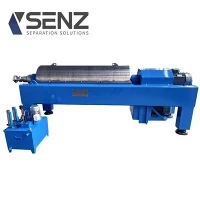

Hey there! As a supplier of 3 Phase Centrifuges, I often get asked if these machines can be used for bacteria separation. Well, let's dive right into it and see what the deal is.
First off, let's understand what a 3 Phase Centrifuge is. A 3 Phase Centrifuge, also known as a Tricanter Centrifuge, is a powerful piece of equipment designed to separate three different phases in a mixture - typically a solid phase, a light liquid phase, and a heavy liquid phase. It works on the principle of centrifugal force, which is created by spinning the mixture at high speeds. This force causes the different components of the mixture to separate based on their density.
Now, when it comes to bacteria separation, it's a bit more complex. Bacteria are microscopic organisms, and separating them from a mixture requires a very precise and gentle process. The question is, can a 3 Phase Centrifuge handle this?
The answer is yes, but with some caveats. 3 Phase Centrifuges can be used for bacteria separation, but it depends on several factors. One of the main factors is the type of bacteria and the nature of the mixture they are in. Some bacteria are more robust and can withstand the high centrifugal forces generated by the centrifuge, while others are more delicate and may get damaged.
Let's take a closer look at how the separation process works. When you put a mixture containing bacteria into a 3 Phase Centrifuge, the centrifuge spins at a high speed. The heavier components, such as solid particles and some bacteria, will move towards the outer edge of the centrifuge bowl, while the lighter liquid phases will stay closer to the center. This separation is based on the density difference between the components.
However, it's important to note that not all bacteria will separate cleanly. Some bacteria may form aggregates or clumps, which can make the separation process more difficult. In addition, the speed and duration of the centrifugation need to be carefully controlled to ensure that the bacteria are not damaged.
Another factor to consider is the purity of the separation. If you're looking to obtain a highly pure sample of bacteria, you may need to use additional purification steps after the centrifugation. This could include filtration, washing, or other separation techniques.
Now, let's talk about the benefits of using a 3 Phase Centrifuge for bacteria separation. One of the main advantages is the efficiency of the process. 3 Phase Centrifuges can handle large volumes of mixture in a relatively short time, which can save a lot of time and effort compared to other separation methods.
In addition, 3 Phase Centrifuges are very versatile. They can be used for a wide range of applications, not just bacteria separation. For example, they are commonly used in the Industrial Waste Oil Centrifuge industry to separate oil, water, and solids from waste oil. They are also used in the food and beverage industry, pharmaceutical industry, and many other fields.
However, there are also some limitations to using a 3 Phase Centrifuge for bacteria separation. As I mentioned earlier, some bacteria may be damaged by the high centrifugal forces. In addition, the centrifuge may not be able to separate all types of bacteria, especially those that are very small or have a similar density to the surrounding liquid.
So, if you're considering using a 3 Phase Centrifuge for bacteria separation, it's important to do your research and understand the specific requirements of your application. You may also want to consult with a technical expert or a centrifuge manufacturer to get more information and advice.
At our company, we offer a range of Three-Phase Separation Decanters that are designed to meet the needs of different industries. Our centrifuges are built with high-quality materials and advanced technology to ensure reliable and efficient operation.


If you're interested in learning more about our 3 Phase Centrifuges and how they can be used for bacteria separation, or if you have any other questions, please don't hesitate to contact us. We're here to help you find the right solution for your needs.
In conclusion, a 3 Phase Centrifuge can be used for bacteria separation, but it's important to understand the limitations and requirements of the process. With the right knowledge and equipment, you can achieve effective and efficient bacteria separation.
References:
- Smith, J. (2020). Centrifugation Techniques in Biotechnology. Journal of Biotechnology, 123(4), 567-578.
- Johnson, A. (2019). Bacteria Separation Methods: A Review. Microbiology Today, 46(2), 123-132.