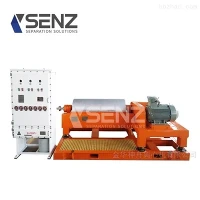

Hey there! As a supplier of laboratory centrifuges, I often get asked about how to measure the centrifugal force in these nifty machines. Centrifuges are super useful in a whole bunch of scientific and industrial applications. They use the principle of centrifugal force to separate substances of different densities, like separating solids from liquids or different types of cells in a biological sample. So, let's dig into how you can measure the centrifugal force in a laboratory centrifuge.
Understanding the Basics of Centrifugal Force
First off, what exactly is centrifugal force? Well, it's the apparent force that draws a rotating object away from the center of rotation. In a centrifuge, this force is what makes the heavier particles move to the outside of the centrifuge tube while the lighter ones stay closer to the center.
The centrifugal force (F) can be calculated using the following formula:
[ F = m \times r \times \omega^2 ]
where:
- (m) is the mass of the object being centrifuged
- (r) is the radius of rotation (distance from the center of the centrifuge to the sample)
- (\omega) is the angular velocity of the centrifuge
The angular velocity (\omega) can be related to the revolutions per minute (RPM) of the centrifuge. The conversion formula is:
[ \omega = \frac{2\pi \times RPM}{60} ]


Measuring the Components for Calculating Centrifugal Force
Measuring the Mass ((m))
This one's pretty straightforward. You can use a balance to measure the mass of the sample you're putting in the centrifuge. Make sure you account for the mass of the tube or container as well, especially if it's a significant part of the total mass. Just place the sample and its container on a calibrated balance, and you'll get the mass value.
Measuring the Radius ((r))
The radius of rotation is the distance from the center of the centrifuge rotor to the center of the sample tube. You can measure this with a ruler or a caliper. Most centrifuges have a specific design for holding the tubes, and the radius can vary depending on the tube size and position. So, measure carefully from the exact center of the rotor to the middle of the sample tube.
Measuring the RPM
To measure the revolutions per minute of the centrifuge, you can use a tachometer. A tachometer is a device that measures the rotational speed of a shaft or disk. There are different types of tachometers, like contact and non - contact ones. A non - contact tachometer, such as an optical tachometer, is often more convenient for measuring the RPM of a centrifuge. You simply point the tachometer at a reflective marker on the centrifuge rotor, and it will give you the RPM reading.
Using the Calculated Centrifugal Force
Once you've measured the mass, radius, and RPM, you can calculate the centrifugal force. Let's say you have a sample with a mass (m = 0.1\ kg), a radius of rotation (r = 0.1\ m), and the centrifuge is spinning at (RPM=3000).
First, calculate the angular velocity:
[ \omega=\frac{2\pi\times3000}{60}= 100\pi\ rad/s ]
Then, calculate the centrifugal force:
[ F=m\times r\times\omega^2=0.1\times0.1\times(100\pi)^2 \approx 987\ N ]
Importance of Measuring Centrifugal Force
Measuring the centrifugal force accurately is crucial for several reasons. In biological applications, different cells or biomolecules require specific centrifugal forces for proper separation. If the force is too low, the separation may not be effective, and if it's too high, it can damage the samples.
In industrial applications, like Centrifugal Thickening Of Sludge, the right centrifugal force is needed to separate the solid and liquid components efficiently. Similarly, in Manure Screw Press and Waste Oil Processing Centrifuge applications, accurate measurement of centrifugal force ensures optimal performance.
Calibration and Verification
It's important to calibrate your centrifuge regularly to ensure accurate measurement of the centrifugal force. You can use calibration standards or reference samples to check the performance of the centrifuge. If you notice any discrepancies in the measured centrifugal force compared to the calculated value, it could be due to issues like a misaligned rotor, a faulty tachometer, or wear and tear on the centrifuge components.
Our Role as a Laboratory Centrifuge Supplier
As a laboratory centrifuge supplier, we understand the importance of accurate measurement of centrifugal force. That's why we offer high - quality centrifuges that are designed to provide consistent and reliable performance. Our centrifuges come with features that make it easier to measure and control the centrifugal force, such as digital RPM displays and adjustable speed settings.
We also provide support and training to our customers on how to measure and calculate the centrifugal force correctly. Whether you're a researcher in a laboratory or an operator in an industrial setting, we're here to help you get the most out of your centrifuge.
Contact Us for Procurement
If you're in the market for a new laboratory centrifuge or need to upgrade your existing one, don't hesitate to reach out. We're happy to have a chat about your specific requirements and help you find the perfect centrifuge for your needs. Let's start a conversation about how we can assist you in getting the right equipment for your work.
References
- "Centrifugation: A Practical Approach" - This book provides in - depth information on centrifugation techniques and the principles behind centrifugal force.
- Manufacturer's manuals for laboratory centrifuges, which often contain detailed information on measuring and operating parameters.