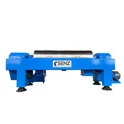

The feed position in a sewage decanter centrifuge is a critical factor that can significantly influence its operational efficiency, separation performance, and overall effectiveness in treating sewage. As a supplier of sewage decanter centrifuges, I have witnessed firsthand the importance of understanding how the feed position impacts the centrifuge's operation. In this blog, we will delve into the various aspects of this impact and explore why it matters in the context of sewage treatment.
Understanding the Sewage Decanter Centrifuge
Before we discuss the impact of the feed position, it's essential to understand how a sewage decanter centrifuge works. A decanter centrifuge is a high - speed rotating device that uses centrifugal force to separate solid particles from a liquid in a sewage mixture. The centrifuge consists of a rotating bowl and a screw conveyor inside it. The sewage is fed into the centrifuge, and as the bowl rotates at high speed, the solid particles are forced to the outer wall of the bowl due to the centrifugal force. The screw conveyor then transports these solid particles towards the discharge end, while the clarified liquid is discharged from the other end.
Impact on Separation Efficiency
The feed position plays a crucial role in determining the separation efficiency of the sewage decanter centrifuge. When the feed is introduced at an appropriate position, it allows for better distribution of the sewage within the centrifuge. If the feed is placed too close to the discharge end of the solid phase, the solids may not have enough time to settle properly, resulting in a higher concentration of solids in the clarified liquid. On the other hand, if the feed is too close to the liquid discharge end, the solid - liquid separation may be incomplete, and the solids may not be effectively removed from the liquid.
For example, in a well - designed centrifuge, the feed is typically introduced at a position that allows the sewage to spread evenly across the cross - section of the bowl. This ensures that the solid particles have sufficient time to sediment under the influence of the centrifugal force. By optimizing the feed position, we can improve the separation efficiency, leading to a higher quality of clarified liquid and a drier solid phase.
Influence on Centrifuge Wear and Tear
The feed position also has an impact on the wear and tear of the sewage decanter centrifuge. If the feed is introduced in a way that causes uneven distribution of the sewage within the centrifuge, it can lead to uneven forces acting on the bowl and the screw conveyor. This uneven loading can result in increased wear on the components, reducing the lifespan of the centrifuge.
For instance, if the feed is concentrated on one side of the bowl, the centrifugal forces will be unbalanced, causing excessive stress on the bearings and other mechanical parts. Over time, this can lead to premature failure of these components, increasing maintenance costs and downtime. By carefully selecting the feed position, we can ensure a more uniform distribution of the sewage, reducing the wear and tear on the centrifuge and extending its service life.
Effect on Processing Capacity
The processing capacity of a sewage decanter centrifuge is another aspect that is affected by the feed position. When the feed is introduced at an optimal position, the centrifuge can handle a larger volume of sewage without compromising the separation efficiency. This is because the proper feed position allows for a more efficient use of the centrifuge's internal space and the centrifugal force.
If the feed position is not optimized, the centrifuge may become overloaded, leading to a decrease in processing capacity. For example, if the feed is introduced in a way that causes the solids to accumulate too quickly in a particular area of the bowl, it can block the flow of the liquid and reduce the overall throughput of the centrifuge. By adjusting the feed position, we can maximize the processing capacity of the centrifuge, making it more cost - effective for sewage treatment plants.
Impact on Energy Consumption
Energy consumption is a significant concern in sewage treatment, and the feed position can have an impact on it. A well - positioned feed allows the centrifuge to operate more efficiently, reducing the energy required to achieve the desired separation. When the sewage is evenly distributed within the centrifuge, the centrifugal force can act more effectively on the solid and liquid phases, requiring less energy to achieve the same level of separation.
On the contrary, if the feed position is improper, the centrifuge may need to operate at a higher speed or for a longer time to achieve the same separation results, leading to increased energy consumption. By optimizing the feed position, we can help sewage treatment plants save on energy costs, which is not only beneficial for the environment but also for the overall operating budget.


Applications and Related Solutions
Our sewage decanter centrifuges are designed to be versatile and can be used in various applications. For Sand & Gravel Washing Water Treatment, the proper feed position is crucial to ensure the effective separation of sand and gravel from the water. By adjusting the feed position according to the characteristics of the sand and gravel mixture, we can achieve a high - quality separation, reducing the water content in the solids and improving the clarity of the treated water.
In Water Treatment Sludge Dewatering, the feed position also plays a vital role. The sludge needs to be evenly distributed within the centrifuge to ensure that the water is effectively removed. Our centrifuges can be customized to optimize the feed position for different types of sludge, improving the dewatering efficiency and reducing the volume of the sludge for disposal.
Another application is Sulfur Foam Separation Centrifuge. The feed position in this case can affect the separation of sulfur foam from the liquid. By carefully selecting the feed position, we can achieve a more efficient separation, improving the purity of the sulfur product.
Conclusion and Call to Action
In conclusion, the feed position has a profound impact on the operation of a sewage decanter centrifuge. It affects the separation efficiency, wear and tear, processing capacity, and energy consumption of the centrifuge. As a supplier of sewage decanter centrifuges, we understand the importance of optimizing the feed position to meet the specific needs of our customers.
If you are in the sewage treatment industry and are looking for a reliable sewage decanter centrifuge, we are here to help. Our team of experts can assist you in selecting the right centrifuge and optimizing the feed position for your specific application. Contact us to start a discussion about your sewage treatment requirements and how our centrifuges can improve your operations.
References
- Smith, J. (2018). Centrifuge Technology in Sewage Treatment. Journal of Environmental Engineering, 25(3), 123 - 135.
- Johnson, A. (2019). Optimization of Feed Position in Decanter Centrifuges. Proceedings of the International Conference on Wastewater Treatment, 45 - 52.
- Brown, C. (2020). Impact of Feed Position on Centrifuge Performance. Sewage Treatment Research Journal, 12(2), 78 - 89.