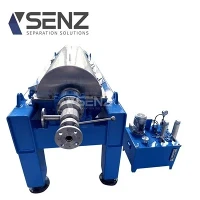

In the field of separation technology, two commonly used devices are the 3 Phase Centrifuge and the hydrocyclone. As a 3 Phase Centrifuge supplier, I am well - versed in the characteristics and differences between these two equipment. This blog aims to provide a detailed comparison to help you better understand which device is more suitable for your specific separation needs.
Working Principle
The 3 Phase Centrifuge operates based on the principle of centrifugal force. When the mixture enters the centrifuge, it rotates at a high speed. Due to the different densities of the components in the mixture, they are separated under the action of centrifugal force. For example, in a mixture of oil, water, and solid particles, the solid particles, being the densest, are thrown to the inner wall of the centrifuge bowl and are discharged through the solids outlet. The oil and water, with different densities, also separate into distinct layers and are discharged through their respective outlets. You can learn more about our 3 Phase Centrifuge on our website.
On the other hand, a hydrocyclone works on the principle of cyclonic separation. The mixture is fed tangentially into the hydrocyclone at high pressure. As the mixture swirls inside the hydrocyclone, the centrifugal force causes the heavier particles to move towards the outer wall and flow downwards towards the underflow outlet, while the lighter fluid or particles move towards the center and are discharged through the overflow outlet.
Separation Efficiency
The 3 Phase Centrifuge generally offers higher separation efficiency, especially for fine particles and mixtures with close - density components. It can achieve a more thorough separation of three phases (solid, liquid - oil, and liquid - water). The high - speed rotation of the centrifuge creates a strong centrifugal field, which can separate particles as small as a few micrometers. This makes it an ideal choice for applications where high - quality separation is required, such as in the food industry for Olive Oil Decanter Centrifuge processes, where it can separate olive oil, water, and olive pulp effectively.


Hydrocyclones, while efficient for separating large - sized particles and for pre - separation tasks, have limitations when it comes to separating fine particles. The separation efficiency of a hydrocyclone is highly dependent on the particle size and density differences. For particles smaller than 10 - 20 micrometers, the separation efficiency of a hydrocyclone drops significantly.
Capacity
3 Phase Centrifuges come in a wide range of capacities, from small - scale laboratory units to large - scale industrial systems. The capacity can be adjusted according to the specific requirements of the application. For large - scale industrial processes, high - capacity 3 Phase Centrifuges can handle several cubic meters of mixture per hour. They are suitable for continuous - flow operations, where a large volume of mixture needs to be processed continuously.
Hydrocyclones also have a certain range of capacities. However, their capacity is often more limited compared to 3 Phase Centrifuges, especially for high - precision separation tasks. Hydrocyclones are more commonly used in situations where a large - volume pre - separation is required, and they can be arranged in parallel to increase the overall capacity.
Energy Consumption
In terms of energy consumption, 3 Phase Centrifuges generally consume more energy due to the high - speed rotation of the centrifuge bowl. The power required to drive the centrifuge motor can be relatively high, especially for large - capacity models. However, with the development of technology, modern 3 Phase Centrifuges are becoming more energy - efficient, and some models are equipped with energy - saving features.
Hydrocyclones, on the other hand, consume less energy as they mainly rely on the pressure of the incoming fluid to operate. The energy is mainly used to pump the mixture into the hydrocyclone at a high pressure. This makes hydrocyclones a more energy - efficient option for some applications, especially when the pressure of the incoming fluid is already available.
Maintenance and Operating Costs
The maintenance of a 3 Phase Centrifuge can be relatively complex. The rotating parts, such as the centrifuge bowl and the drive system, require regular inspection and maintenance to ensure smooth operation. The seals and bearings also need to be replaced periodically. However, the long - term benefits of high - quality separation often outweigh the maintenance costs. Our Sludge Dewatering Unit is designed with easy - to - maintain features to reduce the overall maintenance costs.
Hydrocyclones have a relatively simple structure, which makes their maintenance easier and less costly. There are no moving parts in the hydrocyclone itself, except for the pump that feeds the mixture. However, the wear of the hydrocyclone liner due to the high - speed flow of the mixture can be a concern, and the liner may need to be replaced periodically.
Application Areas
3 Phase Centrifuges are widely used in various industries, including the food industry (such as olive oil production, dairy processing), chemical industry (separation of chemical products), and environmental protection (sludge dewatering). They are suitable for applications where high - precision separation of three phases is required.
Hydrocyclones are commonly used in the mining industry for separating minerals, in the wastewater treatment industry for pre - separation of solids, and in the oil and gas industry for separating oil, water, and gas mixtures at an early stage.
Conclusion
In summary, the 3 Phase Centrifuge and the hydrocyclone have their own advantages and disadvantages. The 3 Phase Centrifuge offers higher separation efficiency, especially for fine particles and close - density components, but it has higher energy consumption and maintenance costs. The hydrocyclone is more energy - efficient and easier to maintain, but its separation efficiency for fine particles is limited.
If you are looking for a high - precision separation solution for your specific application, a 3 Phase Centrifuge may be the better choice. We, as a 3 Phase Centrifuge supplier, are committed to providing high - quality products and professional services. If you are interested in our products or have any questions about the separation process, please feel free to contact us for further discussion and procurement negotiation.
References
- Perry, R. H., & Green, D. W. (2007). Perry's Chemical Engineers' Handbook. McGraw - Hill.
- Svarovsky, L. (2000). Solid - Liquid Separation. Butterworth - Heinemann.