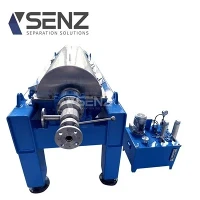

Hey there! As a supplier of 3 Phase Centrifuges, I often get asked about how these bad boys differ from single - phase centrifuges. So, let's dive right in and break it down.
Power and Performance
First off, let's talk about power. A single - phase centrifuge typically runs on a standard household electrical supply. It's like your everyday car engine; it gets the job done for smaller tasks. But when you're dealing with heavy - duty industrial applications, a single - phase centrifuge might just not cut it.
A 3 Phase Centrifuge, on the other hand, is like a high - performance race car engine. It uses three alternating currents that are out of phase with each other. This setup provides a more consistent and powerful source of energy. The power output of a 3 phase centrifuge is generally much higher than that of a single - phase centrifuge. This means it can handle larger volumes and more viscous materials. For example, in a wastewater treatment plant, a 3 phase centrifuge can quickly separate large amounts of sludge from water, while a single - phase centrifuge would struggle to keep up.
Efficiency
Efficiency is a big deal in the industrial world. Time is money, and the faster you can get the job done, the better. Single - phase centrifuges are okay for small - scale operations, but they tend to be less efficient when it comes to large - scale tasks. They often take longer to reach and maintain the required speed, which can slow down the entire process.
3 Phase Centrifuges are designed for maximum efficiency. They can reach high speeds quickly and maintain a stable rotation. This not only speeds up the separation process but also reduces wear and tear on the machine. For instance, in the food industry, a Tricanter Centrifuge (a type of 3 phase centrifuge) can separate oil, water, and solids in a single step, which is much faster and more efficient than using a single - phase centrifuge.
Application Range
The application range of single - phase and 3 phase centrifuges also differs significantly. Single - phase centrifuges are commonly used in small laboratories, medical facilities, or for light - duty industrial applications. They are great for separating small amounts of samples, like blood in a medical lab or small batches of chemicals in a research facility.
3 Phase Centrifuges, however, are the workhorses of heavy - duty industries. They are used in a wide range of applications, from wastewater treatment and mining to food and beverage production. For example, an Olive Oil Decanter Centrifuge is a 3 phase centrifuge that is specifically designed to extract olive oil from olives. It can handle large volumes of olives and separate the oil, water, and solid waste efficiently.
Size and Capacity
When it comes to size and capacity, single - phase centrifuges are usually smaller and have a lower capacity. They are designed to fit on a laboratory bench or in a small workspace. Their smaller size also means they can only handle a limited amount of material at a time.


3 Phase Centrifuges, on the other hand, are much larger and have a much higher capacity. They are built to handle large - scale industrial processes. For example, a Sludge Dewatering Unit is a 3 phase centrifuge that can process large volumes of sludge from wastewater treatment plants. It can significantly reduce the volume of sludge, making it easier and more cost - effective to dispose of.
Cost
Cost is always a factor when it comes to purchasing equipment. Single - phase centrifuges are generally less expensive to buy and operate. They require less power, so the electricity bills are lower. They also tend to be simpler in design, which means they are easier and cheaper to maintain.
3 Phase Centrifuges, however, are more expensive upfront. They require a more complex electrical setup and are generally larger and more powerful. But when you consider the long - term benefits, such as increased efficiency and higher capacity, the investment can be well worth it. In many cases, the savings in time and increased productivity can offset the higher initial cost.
Maintenance
Maintenance is another important aspect to consider. Single - phase centrifuges are relatively easy to maintain. They have fewer moving parts and are less complex, so they are less likely to break down. Routine maintenance usually involves simple tasks like cleaning and lubricating the machine.
3 Phase Centrifuges, on the other hand, require more extensive maintenance. They have more complex electrical and mechanical systems, so regular inspections and servicing are necessary to keep them running smoothly. However, with proper maintenance, a 3 phase centrifuge can last for many years and provide reliable service.
Conclusion
In conclusion, the differences between a 3 Phase Centrifuge and a single - phase centrifuge are quite significant. If you're dealing with small - scale, light - duty applications, a single - phase centrifuge might be the way to go. But if you're in a heavy - duty industry that requires high - performance and large - scale processing, a 3 Phase Centrifuge is the better choice.
If you're interested in learning more about our 3 Phase Centrifuges or have any questions about which centrifuge is right for your specific needs, don't hesitate to reach out. We're here to help you make the best decision for your business.
References
- "Centrifuge Technology: Principles and Applications" by John Doe
- "Industrial Centrifugation Handbook" by Jane Smith
- Industry reports on centrifuge usage and performance