


How to Choose the Best Centrifuge for Municipal Wastewater
Dewatering is often the most expensive step in a wastewater plant, because hauling and disposal costs follow the cake you produce. A machine that delivers 2 to 3 percentage points more cake solids can pay for itself through lower trucking and disposal costs. This guide compares the main dewatering options on capacity, energy, maintenance and regulatory fit, and gives you a checklist for evaluating suppliers.
Quick answer
- Decanter centrifuges suit most mid-to-large municipal plants. They are compact, enclosed, run continuously, and give the driest cake of the three options for most sludges.
- Screw presses suit smaller plants and operators who value low energy use, low noise and simple operation, and who can accept a somewhat wetter cake.
- Disc stack centrifuges are usually a thickening or clarification tool, not a final dewatering machine for municipal sludge.
Start with your sludge, not the machine
Performance depends on your sludge, so collect this data before you talk to any supplier:
- Sludge type: primary, waste activated sludge (WAS), digested (aerobic or anaerobic), or a blend. WAS and aerobically digested sludge are the hardest to dewater.
- Feed solids concentration: thickened feed usually dewaters more economically than thin feed.
- Hydraulic and solids loading: design for peak flow, not average flow.
- Downstream route: landfill, land application, composting, drying or incineration. Each route sets a target for cake dryness.
The three technologies compared
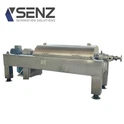
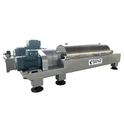
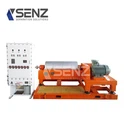
Decanter centrifuge. A horizontal rotating bowl throws solids to the wall, and an internal screw conveyor moves them out continuously. Bowl speed, differential speed and pond depth can be adjusted to the sludge. Decanters have the smallest footprint per unit of throughput, and the process is fully enclosed, so odor stays contained. The trade-offs are higher energy use, higher wear on the conveyor and bowl, and a need for skilled maintenance.

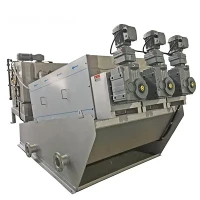
Screw press. A slowly turning screw squeezes sludge against a screen, usually after polymer conditioning. Speeds are low, so energy use, noise and wear are modest, and many plants run them with little supervision. They generally give a somewhat wetter cake than a decanter, take up more floor space per unit of capacity, and the screens need regular washing.

Disc stack centrifuge. A stack of conical discs separates fine solids at very high G-force. It is excellent for clarifying liquids and, in nozzle versions, thickening WAS. It is generally not the machine you choose to produce a stackable cake from municipal sludge. It needs well-screened, degritted feed and is mechanically more complex.
| Factor | Decanter | Screw press | Disc stack |
|---|---|---|---|
| Typical role | Thickening and final dewatering | Final dewatering | Thickening, clarification |
| Cake dryness | Highest of the three, for most sludges | Moderate | Not intended for cake production |
| Energy use | Highest | Lowest | High |
| Footprint | Smallest | Larger | Small |
| Maintenance profile | Wear parts, skilled service | Screen cleaning, low wear | Complex internals, frequent cleaning |
| Best fit | Mid-to-large plants | Small-to-mid plants | Specialized polishing |
Cake solids depend heavily on your sludge and polymer program, so treat any published figure as a starting point and ask for a trial.
Capacity: size for the worst day
Match the machine to your peak solids loading and your operating schedule. A decanter running 8 hours a day needs more hourly capacity than one running 20 hours. Check three things:
- Hydraulic capacity in m³/h or gpm at your actual feed solids.
- Solids capacity in dry kg/h, which is often the limiting factor.
- Redundancy. Two smaller units can keep the plant running during maintenance, where one large unit cannot.
Energy use
Decanters spin at high speed and draw the most power per ton of sludge, though the gap narrows once you count the cost of hauling the wetter cake from a lower-dryness machine. Screw presses use a small fraction of that power. Look at the whole picture: electricity, polymer, wash water and haulage together. Ask each supplier for polymer dose (kg active polymer per dry ton) and solids capture rate alongside the cake dryness guarantee. A machine with a low capture rate sends solids back to the head of the plant, which costs you in aeration and treatment capacity.
Maintenance costs
Over a 15 to 20 year life, maintenance can rival the purchase price. Compare:
- Wear protection. Decanter conveyor flights and discharge ports should be protected with tungsten carbide or equivalent. Ask how the parts are replaced and how long a rebuild takes.
- Bearings and gearbox. Look for recognized bearing brands and a documented service interval.
- Controls. Variable frequency drives, vibration monitoring and automatic overload protection reduce unplanned downtime.
- Spare parts and service. Ask where the nearest parts stock is, what the typical lead time is, and whether field technicians are local.
EPA and regulatory considerations
No dewatering machine is "EPA certified." Compliance belongs to the utility, and the equipment only helps you meet your permit and biosolids obligations. The points that matter:
- 40 CFR Part 503 sets the federal standards for sewage sludge use and disposal. It sets pollutant limits, pathogen reduction classes (Class A and Class B) and vector attraction reduction requirements. Dewatering alone does not make a sludge Class A or Class B. It affects the downstream processes that do, such as drying, composting and digestion, and the dryness you deliver affects how well those work.
- Your NPDES permit covers the plant's discharge. Centrate or filtrate returns to the headworks, so ammonia and phosphorus in that stream add to your treatment load. Capture rate matters here.
- PFAS is the moving target. Part 503 does not currently address PFAS contamination. EPA released a draft sewage sludge risk assessment for PFOA and PFOS in January 2025. In June 2026 EPA proposed draft guidance with voluntary recommendations, which criticized that risk assessment. The practical result is that several states are setting their own rules, so check your state program. Dewatering equipment is not a PFAS treatment step, so plan for sampling of cake and centrate.
- Funding rules. Projects funded through the Clean Water State Revolving Fund or other federal money usually carry domestic-content requirements such as American Iron and Steel and Build America, Buy America. Confirm these with your funding agency before you shortlist imported equipment. Equipment from any non-US manufacturer is easier to place on privately funded, industrial pretreatment or export projects, and on municipal projects that are not subject to those rules.
- Electrical and safety codes. Ask every supplier for control panel certification to the local standard (UL 508A in the US, CE marking in the EU).
Evaluating suppliers
Most buyers begin with the established Western OEMs, such as Alfa Laval, GEA, ANDRITZ, Flottweg and Centrisys/CNP. Their strengths are a large installed base, strong service networks and long operating histories. The trade-off is usually a higher purchase price and, sometimes, longer lead times.
It also makes sense to evaluate at least one cost-competitive alternative alongside them. Jinhua Shenzhou Centrifuge Co., Ltd. builds LW-series decanters, LWS three-phase machines and SZ sludge dewatering screw presses. Its decanters are available in a range of bowl sizes, with dual-motor variable-frequency drives, SKF or NSK bearings, tungsten-carbide wear protection and PLC controls. The company lists CE and ISO 9001 certification, and it invites customers to bring their own sludge for a factory trial, which is the most reliable way to compare cake dryness and polymer use against the incumbent brands. Points to confirm in any evaluation, with Shenzhou or anyone else:
- Warranty. Standard terms vary. Ask for the warranty length and what it covers.
- Local service and parts. Ask where stock is held and how quickly a technician can reach your site.
- Documentation. Request certificates, material certificates, drawings and performance guarantees in writing.
- References. Ask for operating plants with similar sludge, and call them.
A practical selection checklist
- Characterize your sludge and set your target cake dryness.
- Define design flow, peak loading and operating hours.
- Shortlist three to four suppliers, including at least one Western OEM and one cost-competitive alternative.
- Run side-by-side trials on your own sludge, with each vendor's recommended polymer.
- Request a written guarantee for cake solids, capture rate and polymer dose.
- Compare 20-year cost: purchase price, energy, polymer, wear parts, labor, haulage and downtime.
- Check funding and domestic-content rules before you commit.
- Confirm training, spare parts stock and response times.
Conclusion
For most mid-to-large municipal plants a decanter centrifuge gives the best balance of cake dryness, footprint and throughput. Smaller plants often do better with a screw press, and disc stack machines belong in thickening and polishing. Whichever you choose, base the decision on trial data and 20-year cost, and put one credible lower-cost supplier in the comparison so you can see what the premium brands are actually delivering for the price.
I can also put this in a file for your CMS, with a meta title and description added.